How to Buy a Telegram Username on Fragment

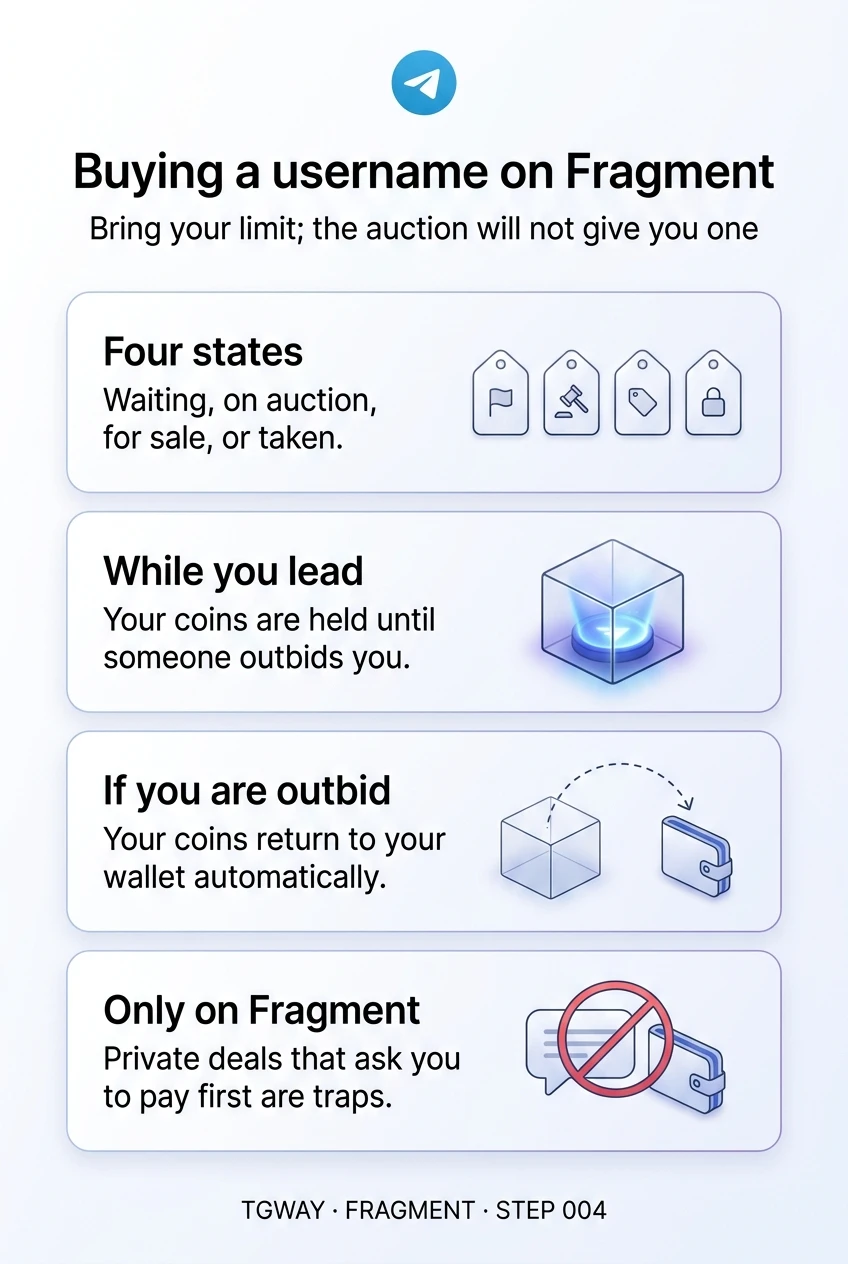
A collectible username can be bought on Fragment in one of a few ways, depending on the state the name is in: some are waiting for a first bid, some are already being auctioned, some are listed by an owner at a set price, and some belong to someone who has not offered them at all. Each state has its own button and its own rules.
The mechanics are the easy part. The hard part is that auctions are built to move your number. A limit you set while bidding is not a limit; it is your current position. This step walks through each way of buying, what happens to your coins at every stage, and how to decide what a name is worth to you before the auction starts deciding for you. It says nothing about whether a name is a good investment, because this track does not give that kind of advice.
What you will be able to do after this step
- check_circle Read a name's status on Fragment and know which way of buying it applies.
- check_circle Follow what happens to your coins when you bid, lead, get outbid or win.
- check_circle Set a spending limit before you open the auction page, and keep it.
checklist Before any of this: do you need a collectible?
Step 003 set out what a collectible username actually gives you: the same username features every Telegram account already has, plus one thing, the ability to transfer or sell it. If you only want a good name for your profile or channel, first check whether it is free to claim in the Telegram app itself. Many names are, and a free one costs nothing to keep.
Buying makes sense when the specific name matters, it is not free, and you accept that you are paying for transferability rather than for anything the name will do. Everything below assumes you have got that far, have signed in to Fragment with Telegram and connected a wallet as described in Step 002, and hold coins you are prepared to spend.
Which way of buying applies
Search for the name on Fragment and look at its status. Pick the one you see.
A name listed and waiting for its first bid
Some names sit on Fragment with a minimum bid and no auction running yet. The first bid at or above that minimum starts the auction, and from that moment the clock runs for everyone. Fragment states the auction length on the page.
This is the moment people underestimate. Placing the first bid does not buy the name; it announces that someone wants it and opens the contest. If the name matters to you, decide your limit before you place that bid, because the next person to see it may have a larger one.
Your first bid starts a contest. It does not end one.
An auction already running
The page shows the current highest bid and the time left. To take the lead you place a higher bid from your connected wallet, and you approve that payment in the wallet itself. While you lead, those coins are held for the auction. If someone outbids you, Fragment returns your coins to your wallet automatically, usually within seconds, though the blockchain can occasionally make it slower.
Bids are settled in the order they reach the blockchain, not the order people pressed the button. In the last minutes, two people can bid at almost the same moment and only one arrives first. When the auction ends, the name goes to the highest bidder and is held by the wallet that paid.
Leading means your coins are held. Losing means they come back. Winning means they are spent.
A name its owner listed at a set price
Collectible usernames can also be resold by their owners at a fixed price. You see the price, you pay it from your wallet, and the name transfers to that wallet. There is no bidding and no waiting, but the listing can close or be bought by someone else while you think.
A fixed price is simply the owner's asking price. It is not an appraisal, and it is not what the name is worth to you. Compare it with the limit you set before you looked, not with the listing next to it.
A fixed price is what the seller wants, not what the name is worth.
A name that belongs to someone and is not for sale
Fragment lets you make an offer on a name marked as taken, and says plainly that making the offer costs a small fee you do not get back, whether or not the owner accepts. The owner may ignore it; many do.
This is also where outside approaches appear. Someone may message you on Telegram claiming to own the name and offering to sell it privately if you send coins first. A real sale of a collectible happens on Fragment, where the name moves to your wallet as part of the same transaction. A deal that asks you to pay somewhere else and trust that the name will follow is the standard way people lose coins.
Offers go through Fragment. Private deals that ask you to pay first are the trap.
savings Set the limit before the page does
Auctions work on a simple piece of psychology. Once you are leading, being outbid feels like losing something you already had, and the natural response is to bid a little more. Each step is small, the timer is short, and the other bidder is invisible. People who go in without a number end up paying whatever the last few minutes demanded.
The only protection is a number decided before you open the auction, somewhere the page cannot reach: written on paper, typed into a note. Decide it by asking what the name is worth to you if you could never sell it, because you may not be able to. Then treat that number as the end of the auction for you, however close the next bid seems.
A limit set in advance, and one set in the moment
The same person, the same name, the same auction.
task_alt Limit written down first
Decided the night before, based on what the name is worth kept forever.
Outbid near the end, above the number: stops, and gets the coins back.
Wins some auctions, loses others, and never regrets the price.
cancel Limit decided while bidding
Starts with a rough idea and a sense that the name "should" be theirs.
Outbid near the end: "just one more", several times in a row.
Wins at a price they would never have agreed to on the first day.
In an auction, the number you bring is the only limit that holds.
receipt_long What the full cost includes
The winning bid or the listed price is most of the cost, but not all of it. Every transaction on the TON blockchain needs a small network fee, paid in Gram from the same wallet, so keep a little more than the price in the wallet or the payment can fail. Fragment also describes a platform fee on each sale, which matters later if you ever resell. The current figures are on Fragment's own pages; check them there rather than trusting a number from a guide or a chat.
Two further costs do not appear on any receipt. The coins are gone once the name is yours: there is no refund because you changed your mind. And a collectible is only as easy to sell as the number of people who want that exact name, which for most names is very few. Buy a name you would be happy to keep, not one you plan to flip.
verified_user Staying on the real site
Every step of a purchase happens on fragment.com, and every payment is approved inside your own wallet. Type the address yourself or use a bookmark rather than following links from messages, because lookalike pages that copy Fragment's design are a known way to get people to approve the wrong payment. On the approval screen in your wallet, read the amount before you confirm; the page you came from cannot change what that screen shows.
Nobody legitimate needs your wallet's recovery phrase to help you buy, bid or win. Fragment never asks for it, and neither does any genuine seller or support account.
touch_app Try it now — before your first bid
- Check whether the name is free In the Telegram app, try setting the name as a username. If it is available there, you do not need Fragment at all.
- Look it up on Fragment Type fragment.com yourself, search for the name and note its status: waiting for a bid, on auction, for sale or taken.
- Write down your limit Decide what the name is worth to you if you could never sell it. Write the number somewhere outside the browser.
- Check the wallet holds enough The price, plus a small margin for network fees. Not more than you are prepared to lose to a mistake.
- Bid or buy once, then stop at your number If you are outbid above your limit, let it go. Your coins come back, and the name was only ever worth the number you wrote.
The same auction psychology applied to collectible gifts: why a limit set while bidding is only your current position, and when buying later on the resale market is the better route.
help Questions
What happens to my coins if I am outbid?
Fragment returns them to your wallet automatically, usually within seconds. Occasionally the blockchain takes longer. You do not need to claim them, and nobody who contacts you about a "stuck refund" should be given your wallet details.
Can I cancel a bid?
Treat every bid as binding. Once it is recorded, it stands until someone outbids you or the auction ends with you in the lead. That is why the limit has to be set before you bid, not after.
How long do auctions last?
Fragment shows the length and the time remaining on each auction's page, and the rules can change, so read them there. What does not change is that the final minutes are where most of the pressure is, which is the reason to arrive with a number.
Someone offered to sell me a username outside Fragment. Is that safe?
No. A collectible username moves to your wallet as part of a Fragment transaction. A private deal where you send coins first and wait for the name has no mechanism that makes the name follow. It is the most common way people lose coins in this market.
I won. Is the name on my profile now?
The name belongs to the wallet that paid. Putting it on your profile or a channel is a separate step, and the name stays yours even if you never assign it. Step 005 covers assigning it.
Buying a username on Fragment
The four states a name can be in, what happens to your coins when you lead, get outbid or win, and why the limit has to come with you. Tap to open it at full resolution.