Pick Your Telegram Group's Language Before It Opens

Nobody writes "English speakers only" in a group description, and yet every group decides who it is for long before anyone joins. The description is in one language, the rules are in one language, the first ten conversations are in one language. A newcomer who cannot read them does not argue; they leave.
Language is the first filter on who stays, and it is set by what you write before launch, not by what you say later. This step covers the three quiet decisions that shape who can take part: the language, the time zone your group runs on, and the small habits that let people who cannot hear a voice message or read a picture follow along. None of them is right or wrong. All of them are easier to decide now than to change later.
What you will be able to do after this step
- check_circle Choose a language model for your group and say it clearly up front.
- check_circle Plan events and announcements for members in other time zones.
- check_circle Adopt a few habits that make the group readable for more people.
"Any language welcome", or one language stated
Two groups about the same hobby, three months after launch.
forum Left open
Four languages in one chat; most members understand only one thread at a time.
Questions in the minority language go unanswered.
Admins cannot tell whether a message is rude, spam or fine.
The group slowly becomes the language of whoever posts most.
translate Stated in the description
"Main language: English. Spanish topic for Spanish speakers."
Newcomers know at once where they can write.
Each language has someone who can read and moderate it.
Members who do not fit know to look for another group, instead of feeling ignored.
The second group is not less welcoming. It is honest about who it can serve.
Which one fits your group?
The real limit is not how many languages your members speak, but how many your moderators can read.
Everyone writes in one shared language
The simplest to run and the easiest to moderate. It fits most new groups. Say the language in the description and the first pinned message, and gently point people to it when they write in another.
Telegram can translate individual messages, so readers can follow a stray post; a shared language keeps replies in one conversation.
The default, if you say it out loud.
One main chat, with a topic for another language
In a group with topics turned on, a separate topic can hold a second language, so its speakers have a place without splitting the whole group. It works when at least one moderator reads that language.
Keep the rules and important announcements in both, pinned where each group of speakers will see them.
A room for a second language, with someone who reads it.
A separate group for each language
The cleanest for large communities, and the most work. Each group needs its own moderators and its own life; a group with nobody to answer in it is worse than none.
A shared folder link can offer all of them in one tap, so people choose theirs on the way in.
Only for languages you can staff.
One chat, but announcements in two languages
Conversation stays in one language, while rules and announcements appear in two. It helps a group whose members mostly share a language but include newcomers who do not.
Put the shorter version first and keep both current; an out-of-date second language quietly tells its readers they are an afterthought.
Good for notices, not for conversation.
schedule Time zones
If your members live across several regions, "tonight at eight" means something different to each of them. A few habits keep everyone included:
- Always write the time zone, and the day. "Thursday 18:00 UTC" can be converted; "tonight" cannot.
- Move regular events around. If a weekly call is always at a time that suits one region, the others will never join it. Alternating slots is fairer.
- Make important things readable later. A summary after a live voice chat, pinned for a day, lets the people who were asleep catch up.
- Remember your coverage. The hours your members are most active may be the hours nobody moderates, as Step 008 described.
accessibility Small habits that let more people follow
Accessibility in a chat is mostly about not locking information into one format.
| Habit | Who it helps | How to do it |
|---|---|---|
| Text alongside voice messages | People who cannot listen right now, cannot hear, or read the language better than they hear it | Put the key facts, time and place in text; use voice for tone |
| Captions on images of text | Screen-reader users, and anyone searching the chat later | Add a one-line caption saying what the image shows |
| Plain words in rules | Non-native readers, and machine translation | Short sentences, no slang or in-jokes, one rule per line |
| Meaning not carried by colour or emoji alone | Colour-blind readers, and anyone seeing a fallback emoji | Say "approved" in words, not just a green mark |
| Readable links | Everyone deciding whether to tap | Link text that names the destination, not "click here" |
touch_app Try it now — ten minutes
- Write the language line One sentence for the description: the main language, and where others can go.
- Check your moderators' languages Only offer a language someone on the team can read.
- Pick a time-zone format One way of writing times that every announcement will use.
- Reread your rules as a newcomer Remove slang, split long sentences, and add a caption to any image that carries rules.
Why opening a second language means opening a second comment room you must be able to read, what machine translation gets wrong, and why the description and pinned message are the best place to spend human translation.
help Questions
Is it unwelcoming to ask people to use one language?
Not if you say it kindly and early. A clear language line tells people what to expect before they join. What feels unwelcoming is joining a group, writing in your language, and being ignored because nobody can read it.
Can I rely on translation instead of choosing a language?
Translation helps readers follow a message, and Premium users can translate whole chats. It is not a moderation tool: machine translation is fluent even when it is wrong, especially with slang, numbers and negatives, and a moderator cannot judge tone through it reliably.
How do I handle someone who keeps posting in another language?
Point them to the language line, or to the topic or group for their language, once and politely. Most people simply did not see it. Only treat it as a rule problem if it continues after they know.
Does the group's language setting exist somewhere in Telegram?
There is no single "group language" switch. Your group's language is whatever your description, rules and first conversations are written in, which is why they need to be decided before launch.
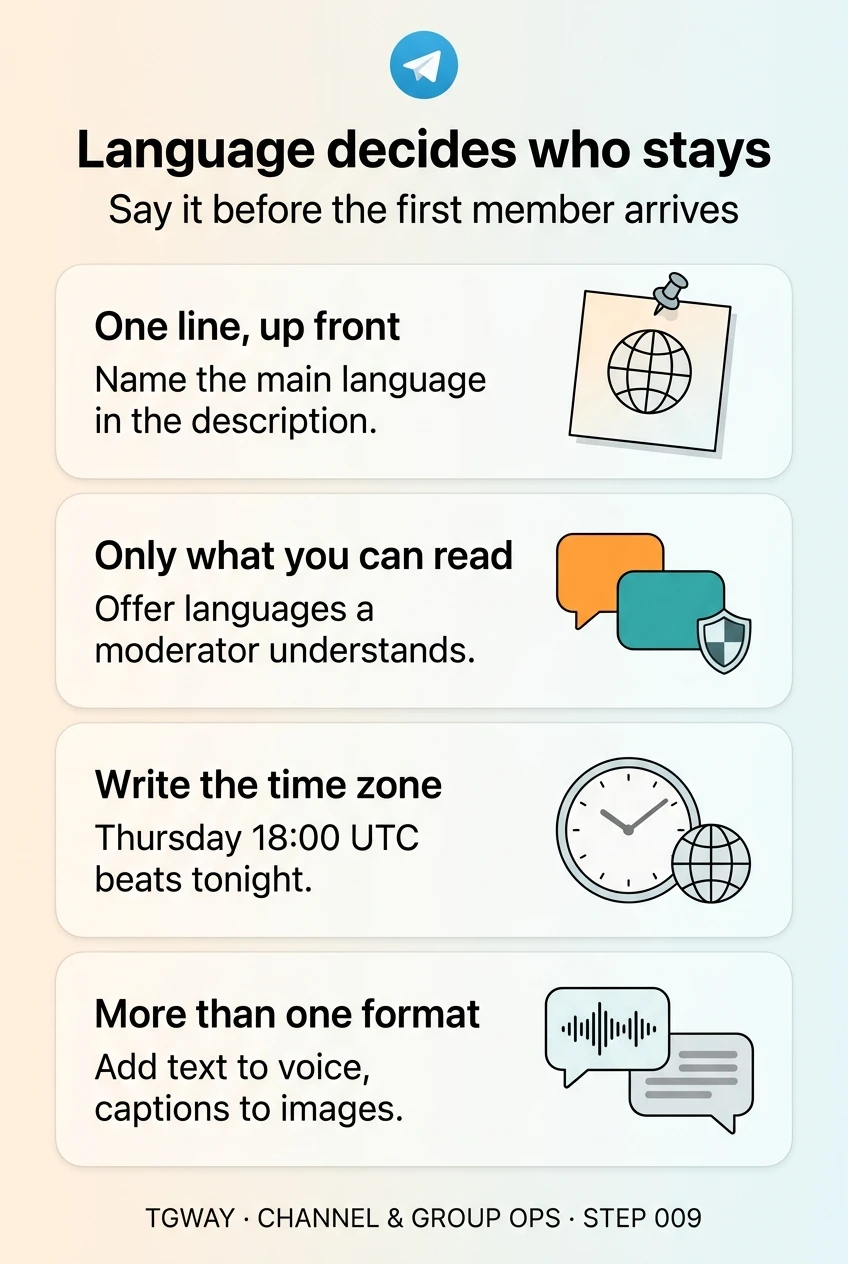
Language decides who stays
Four language models for a new group, why you should offer only languages a moderator can read, how to write times across time zones, and small habits that let more people follow. Tap to open it at full resolution.