Custodial or Self-Custody Crypto Wallet?

Every crypto wallet answers one question differently: who holds the keys that control what is inside it? In a custodial wallet, a company holds them for you, much as a bank holds your money. In a self-custody wallet, the keys are derived from a recovery phrase that only you have, and nobody else can touch the contents.
This is usually sold as "your keys, your crypto" versus convenience. The honest version is more balanced. A company that can freeze your wallet is also a company you can call when something goes wrong. Neither choice removes risk; each moves it to a different place. This step shows exactly where.
What you will be able to do after this step
- check_circle Explain the difference between custodial and self-custody wallets in one sentence.
- check_circle Predict what happens in each when you lose a phone, forget a password or get scammed.
- check_circle Choose the kind that matches what you will actually do with it.
key The one difference
A wallet does not really contain coins. It contains the keys that authorise moving them on a public network. Whoever has the keys can move what they control; whoever does not, cannot.
With a custodial wallet, you log in to a service, and the service moves things for you. Your access depends on your account with that company, and the company can recover it, restrict it or freeze it according to its own rules and the law it operates under.
With a self-custody wallet, the keys come from a recovery phrase, a list of ordinary words shown to you once when the wallet is created. Anyone who has that phrase has the wallet, on any device, forever. Nobody else can restore it for you, because nobody else has it.
history Six things that can happen, and what each kind does
Read down each column. The two kinds are not better and worse; they fail in opposite situations.
| What happens | Custodial wallet | Self-custody wallet |
|---|---|---|
| You lose your phone | Sign in on a new device through the service | Restore with your recovery phrase, and only with it |
| You lose the password or phrase | The company can usually help you regain access | The contents are gone for good |
| The company restricts accounts | Your balance can be frozen | Nothing can freeze your wallet |
| The service shuts down | You depend on how it winds down | Your wallet works in any compatible app |
| A scammer gets you to hand over access | Support may be able to step in quickly | No one can reverse or block it |
| Someone else needs access after you | Follows the company's procedures | Only possible if they can find the phrase |
The pattern is simple. Custodial wallets fail when the company does; self-custody wallets fail when you do. The question for you is which of those two you trust more with the specific amount you plan to keep.
Which wallet was it?
Tap the answer for each situation.
Mia forgot her password but got her balance back after verifying her identity with the provider.
Only a company holding the keys can restore access after a forgotten password. With self-custody there is nobody to verify you to.
Sam's phone was stolen. He typed his list of words into a wallet app on a new phone and everything was there.
The recovery phrase is the wallet. Anyone who types it into a compatible app has it, which is exactly why Sam must never share it.
Leo's balance was locked while the provider reviewed his account, and he could not move anything for a week.
The same power that lets a company help you also lets it hold your balance under its rules. That is the trade, not a flaw.
task_alt
balance Choosing for what you will actually do
Small amounts, occasional use, and you want someone to call: a custodial wallet is a reasonable choice. It behaves like the apps you already know, and forgetting a password is not a disaster.
You want to hold collectible items or use apps that need your own wallet: self-custody is often required, because those items and apps work with wallets you control directly.
You are not confident you can keep a phrase safe for years: be honest about it. Self-custody asks for a kind of care most people have never had to give anything. For ordinary users, a lost or carelessly stored phrase is a far more likely way to lose a wallet than any technical attack.
You are keeping something you could not afford to lose: neither kind makes that safe on its own. A custodial balance of that size depends entirely on one company; a self-custody wallet of that size depends entirely on one piece of paper. Keep only what you need for what you are doing, and treat any wallet on your phone as spending money rather than savings.
Many people end up with both: a custodial balance for everyday use and a self-custody wallet for items that need it. That is fine, as long as you always know which one you are looking at, which Step 003 helps with.
touch_app Try it now — five minutes
- Say which failure worries you more A company that freezes your balance, or you losing a piece of paper. Your answer points to the kind that suits you.
- Look at a wallet you already have If you were never shown a list of words to write down, it is almost certainly custodial.
- If it is self-custody, find the phrase Without opening the wallet. If you cannot put your hand on it in a minute, that is the first problem to fix, and Step 007 covers storing it.
Why transfers never reverse, the three positions including having no wallet, and the rule that nobody legitimate ever asks for a recovery phrase.
help Questions
Is self-custody safer?
Safer from a company's decisions, not safer overall. It removes the risk of being frozen and adds the risk of losing everything through one mistake with a phrase. For many people the second risk is larger.
Can a custodial wallet steal my money?
You are trusting the company to hold and return what is yours, just as with any financial service. Choose one you would trust with the amount in question, and do not keep more there than you would be comfortable having frozen for a while.
What exactly is a recovery phrase?
A list of ordinary words, shown once when a self-custody wallet is created, from which its keys are calculated. It is the wallet itself in written form. Anyone who has it controls the wallet; nobody legitimate will ever ask you for it.
Can I move from one kind to the other?
Yes, by sending what you hold from one wallet to the other. Send a small amount first and confirm it arrived before moving the rest, because a transfer to a wrong address cannot be undone.
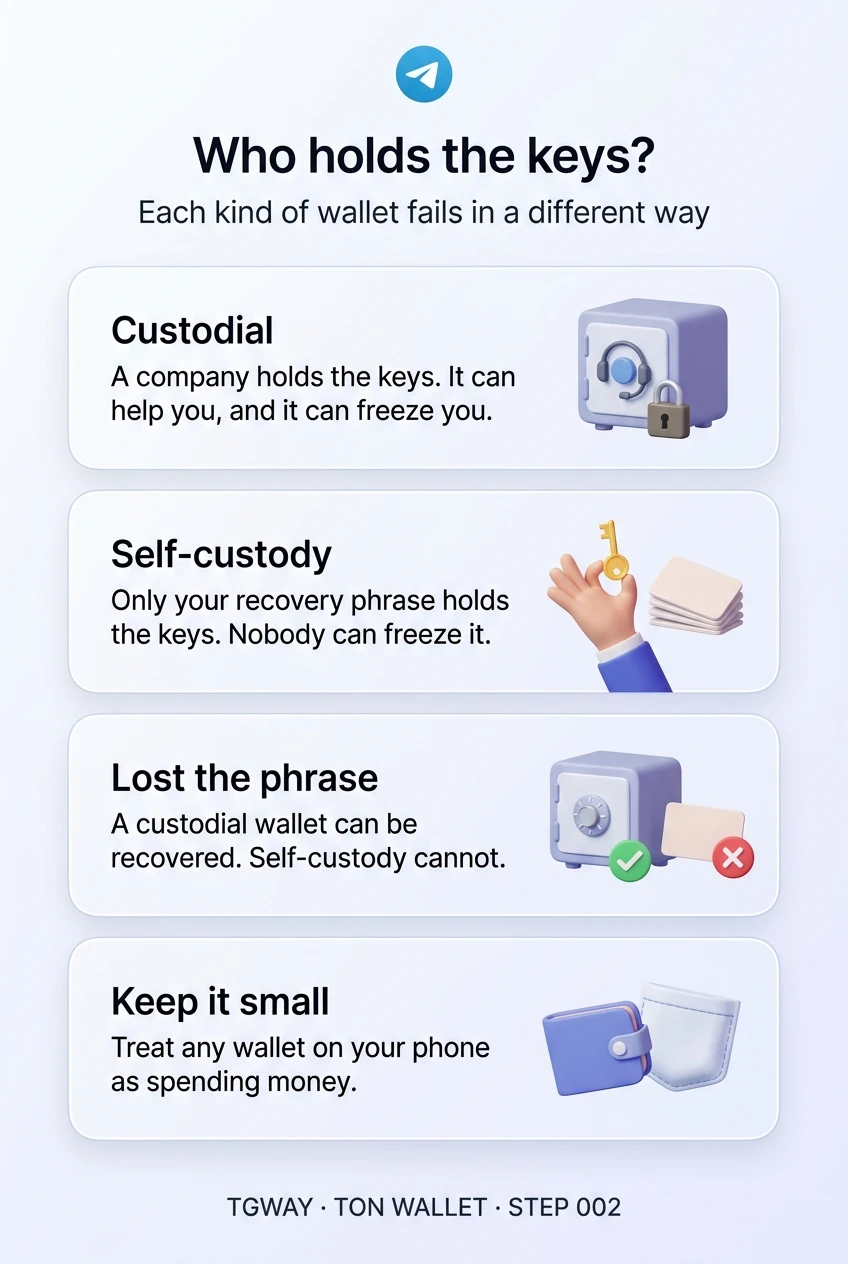
Who holds the keys?
The one difference between the two kinds of wallet, and how each one fails. Tap to open it at full resolution.