What Your Friends Pay for Your Mini App Invite Bonus

Many mini apps give you something for bringing in other people: extra points, a faster level, a share of what your friends earn or spend. The mechanism is always the same. You get a personal link, you send it to people, and the app counts who arrived through you.
What the app counts, your friend does not see. A link with a reward attached looks exactly like a link sent out of friendship, and that is precisely why it works. This step looks at what your invite costs the people who tap it, why their trust is the thing being spent, and how to invite in a way you would be happy to be invited yourself.
What you will be able to do after this step
- check_circle Recognise the kinds of invite reward and what each one depends on.
- check_circle Name what a friend gives up when they follow your link.
- check_circle Invite honestly: say what you get, and choose who to send it to.
link How an invite link works
An invite link is an ordinary link to the mini app with a code added to it, unique to you. When someone opens the app through it, the app records that they came from you. After that, depending on the app, you get a one-off bonus, or a share of whatever they do from then on.
Nothing about the link tells your friend this. In the chat it looks like any other link, often with a friendly preview written by the app. Some apps show "invited by" somewhere inside, most do not. So unless you say so, they have no way of knowing that tapping it is worth something to you.
table_chart Four kinds of reward
The rewards differ in one important way: how long your bonus keeps depending on what your friend does.
| Reward | You get | Your friend gives | Worth saying? |
|---|---|---|---|
| A bonus when they join | Points or credit, once | A few minutes, and a new bot in their chat list | Yes, briefly |
| A share of what they earn | Part of their points, for as long as they play | Their ongoing time, which now also pays you | Yes: they are working for you too |
| A share of what they spend | A cut of their purchases, often paid in Stars | Real money, of which part goes to you | Always |
| Invites needed to unlock something | Access to the next level or feature | Being one of the people you had to recruit | Yes, and only to people who want it |
Some mini apps and bots take part in Telegram's affiliate programmes, where the person who referred a user receives a share of what that user spends in Stars, for a period the developer sets. That is the third row, run through Telegram itself. It is a legitimate model; it is also the one where honesty matters most, because money is changing hands.
handshake What your friend actually pays
- Their trust in you. They are not trusting the app; they are trusting your judgement. If the app turns out to be a waste of time, or worse, that is how they will remember your message.
- Their basic profile. Opening a mini app shares the same information with its operator as any other, as Step 003 described.
- Their time, on the app's schedule. Invite-driven apps are usually the ones with daily timers and tasks, from Step 007.
- Sometimes their money. If your reward comes from their spending, every purchase they make is partly a payment to you.
None of this means you should never send an invite. It means an invite is a small recommendation, and a recommendation from you is worth something because you do not give them carelessly.
quiz Would you send it?
A game gives you ten percent of everything your friends earn. You have played it for two days. What is the honest way to share it?
A share of their earnings means they are, in part, playing for you. Saying so takes one line and lets them decide knowingly. Posting it everywhere spends your credibility with people who never asked, and many groups treat referral links as spam.
An app says you need five invites to "unlock withdrawals". What should you conclude?
Making withdrawals depend on recruiting is a classic sign that the app grows by spreading, not by paying. Before sending anyone anything, check whether anyone has actually withdrawn, and never pay a fee to release earnings.
A friend asks why they should try an app you invited them to. What is the most useful answer?
Your real experience is the only thing you can honestly vouch for. Nobody can promise what points will be worth, and "everyone is using it" is what the app's own marketing says.
task_alt
verified Inviting well
- Say what you get. "I get a bonus if you join" is enough. It changes nothing for most friends, and it keeps you honest with the ones for whom it matters.
- Choose the people. Send it to someone who would enjoy the app, not to your whole contact list.
- Send it once. One message, no reminders. If they are not interested, that is the answer.
- Respect groups. Posting referral links in a group you did not create is often against its rules, and admins remove it as spam.
- Only invite to what you would stand behind. If the app asks for a wallet or money, try it yourself first, and never invite someone into a step you have not taken.
touch_app Try it now — five minutes
- Find where each app shows your invites Most have a "friends" or "invite" screen. See what kind of reward from the table it uses.
- Look back at invites you have sent Did the message say you get something? If not, and the reward is ongoing, a short follow-up is fair.
- Write your one line Something like "I use this for X, and I get a bonus if you join." Keep it for next time.
Why a message a mini app fills in arrives in your name with no sign of where it came from, why you can shorten it before sending, and why a rewarded invite deserves one honest line.
help Questions
Can my friend tell that my link has a reward on it?
Usually not. The code is part of the link, and the preview looks the same as any other. Some apps mention who invited you inside, but you cannot rely on that. If it matters, say it.
Does the app learn anything about my friend from my invite?
It learns that they came from you, which links the two of you in the operator's records. Beyond that, it learns what any mini app learns when opened. It does not get your contacts or your chats.
Is it wrong to earn from invites?
No. Recommending something you like and being rewarded for it is common. What makes it uncomfortable is hiding it, pushing it on people who did not ask, or recommending something you have not tried.
A stranger sent me an invite link. Should I open it?
A stranger has no reason to recommend anything to you except the reward. Treat it as an advert. If you are curious about the app, find it through its bot or the app directory instead of the link, so the stranger is not paid for your attention.
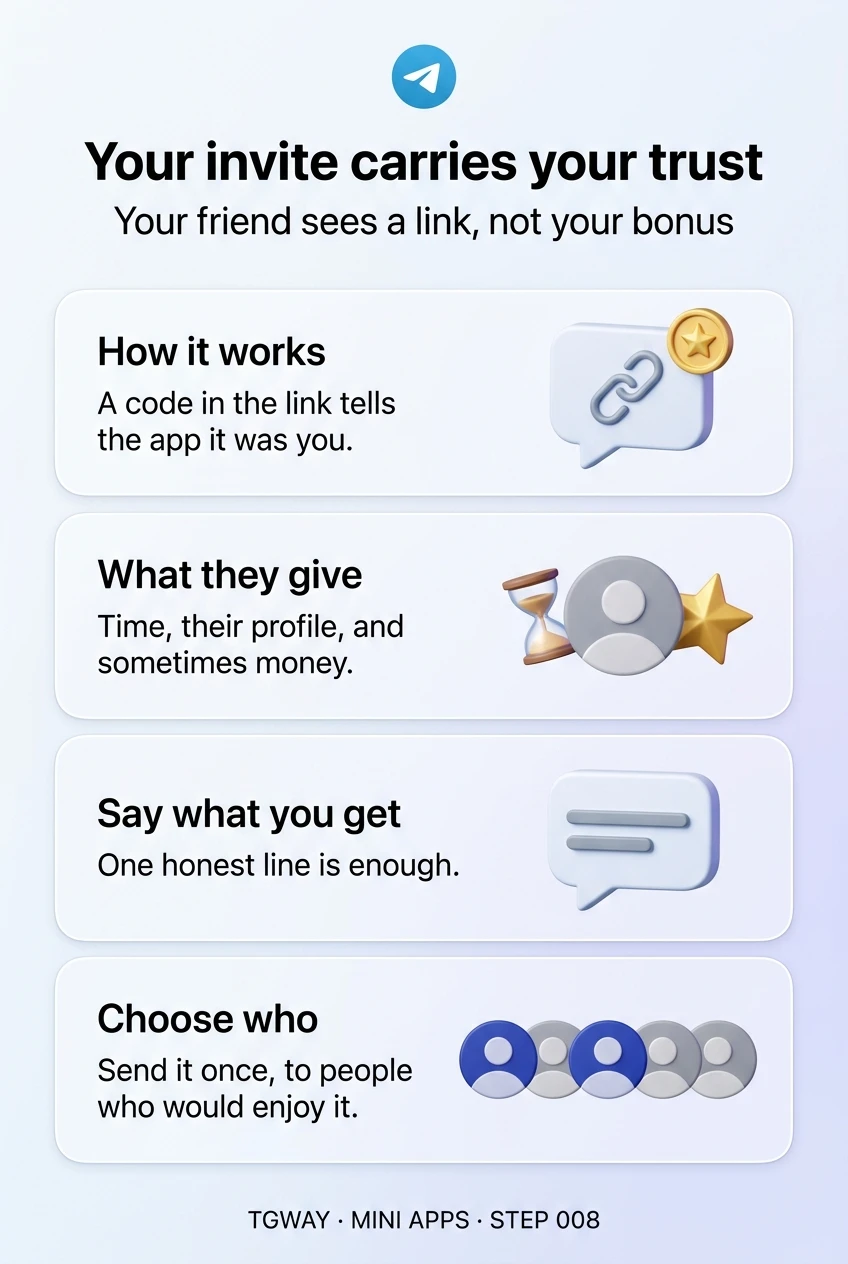
Your invite carries your trust
How an invite link records that a friend came from you, the four kinds of reward and what each costs the person who taps it, and how to invite honestly. Tap to open it at full resolution.