Telegram Security Myths and What Is Actually True

Most of what people believe about Telegram security is half right. "Secret Chats are safe." "Two-Step Verification stops hackers." "A blue tick means it is real." Each of these is true about something. The trouble starts when a belief is stretched to cover things it never covered, and someone relaxes exactly where they should be careful.
A myth is rarely a lie. It is a true statement with its edges forgotten. This step closes the first module of the track by taking seven common beliefs and marking where each one stops. Nothing here is new; it draws the line around what Steps 001 to 009 already covered, so you can say precisely what protects you, and from what.
What you will be able to do after this step
- check_circle Say exactly what Secret Chats, Two-Step Verification and badges protect.
- check_circle Spot the moment a true statement is being stretched too far.
- check_circle Correct a friend's belief without replacing it with a new myth.
quiz True, or stretched too far?
Try these before reading on. Each answer says where the edge is.
"All my Telegram chats are end-to-end encrypted."
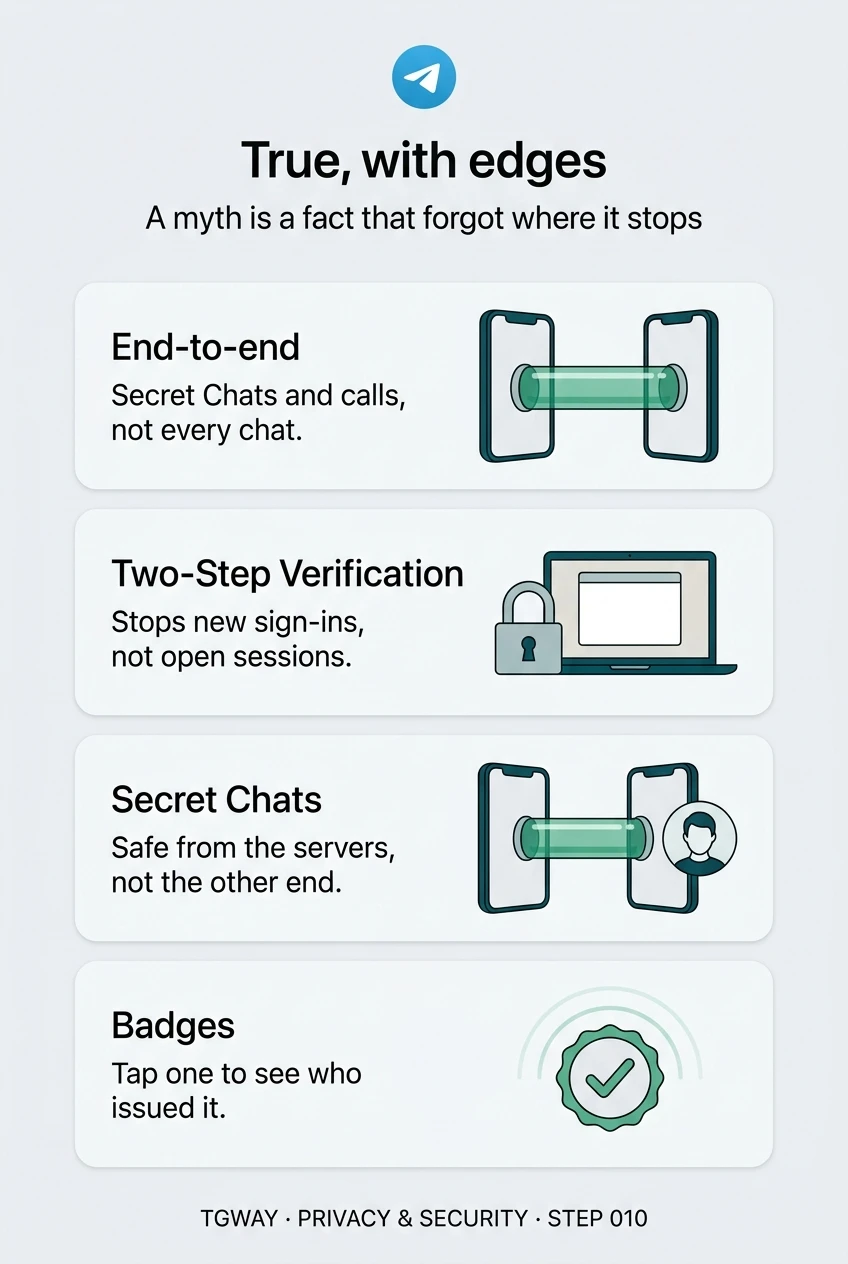
Ordinary chats, groups and channels are cloud chats: encrypted in transit and in storage, with the keys held by Telegram so your history syncs across devices. Secret Chats and one-to-one calls are end-to-end encrypted. Step 002 has the full picture.
"With Two-Step Verification on, nobody can get into my account."
It protects every new login. It does not sign anyone out, and it cannot help if you type the password into a fake page. That is why the Step 008 baseline pairs it with a devices check.
"If I delete a message for everyone, it no longer exists."
Deleting for everyone removes the message for all participants of that chat. Copies made before you deleted it, a forward, a screenshot, a notification someone already read, are outside the chat and stay.
"Hiding my phone number makes me anonymous."
Privacy settings control who sees your number, and who can find you by it. Telegram still has it, and your username, photo and messages can identify you on their own. Step 003 explains why the number is the root of the account.
task_alt
Where each belief stops being true
These three cause the most real trouble, because people act on them.
"Anything in a Secret Chat is safe"
A Secret Chat keeps messages off Telegram's servers and on the two devices that took part. That is a real protection against the messages being stored or read anywhere else.
It does nothing about the other person, who can still read, remember or photograph what you send, and nothing about an unlocked phone at either end. Most real problems come from exactly those two places.
Safe from the servers, not from the other end.
"A badge next to the name means I can trust them"
Different marks mean different things. A verification mark says an identity was confirmed. A Premium star says the account pays for a subscription, which a scammer can do too. Neither says anything about how the account behaves.
And any symbol typed into a display name is just text. The only reliable check is to tap the mark and read who issued it.
A badge is a statement about identity, never about honesty.
"Content protection means nobody can copy it"
Restricting saving and forwarding works inside Telegram: the forward button disappears and saving is blocked. Whether screenshots are blocked depends on the device.
A second phone pointed at the screen defeats every one of these, and no app can prevent it. Treat anything you share as something that could be copied by anyone who can see it.
A barrier inside the app, not outside it.
Stretched too far, or held precisely
Someone moves a sensitive conversation to a Secret Chat.
sentiment_satisfied "Now it is safe"
They share things they would not want seen, because the lock icon is there.
Their phone has no screen lock; a housemate reads the chat.
The other person screenshots a message and shares it.
fact_check "Now the servers cannot see it"
They use the Secret Chat for what it protects: copies on servers and other devices.
They lock the phone, because the chat is only as safe as the device.
They still share only what they could live with the other person keeping.
Same feature. The second person knows where it ends.
record_voice_over Correcting a myth without making a new one
When a friend says something stretched, the tempting reply is the opposite extreme: "Telegram is not secure at all." That is a myth too, and a more harmful one, because it pushes people to give up on protections that do work. A better correction names the edge: "Secret Chats keep it off the servers, but not away from the person you send it to." One sentence, true on both sides.
touch_app Try it now — five minutes
- Pick one belief you rely on About Secret Chats, your password, deleting, or badges.
- Finish the sentence "This protects me from ... but not from ..." If you cannot fill in the second half, reread the step that covers it.
- Review your first module The track index lists Steps 001 to 010. If one of them surprised you here, that is the one to reread.
Why a Secret Chat protects against the line and the service but not the person you talk to, how key verification works, and why most conversations are better off as cloud chats.
help Questions
So is Telegram secure or not?
That question has no single answer, which is the point of this step. Some things are strongly protected, some are protected in a specific way, and some are not protected by any app, such as what the other person does with what you send. The useful question is always "secure against what?"
Why are ordinary chats not end-to-end encrypted?
Because cloud chats keep your full history on every device you sign in to, including new ones. End-to-end encryption ties messages to specific devices, which is what Secret Chats do. It is a trade-off between convenience and where copies can exist.
Can Telegram staff read my Secret Chats?
No. The servers only pass on data they have no key for. The weak points of a Secret Chat are the two devices and the two people, not the servers.
What comes after the first module?
The next module turns to the scams ordinary accounts actually meet: the "I sent you a code by mistake" trick, fake support accounts, deletion warnings and QR login theft. The baseline from Step 008 is the foundation for all of them.
True, with edges
Seven common beliefs about Telegram security and exactly where each one stops being true, from end-to-end encryption to badges and content protection. Tap to open it at full resolution.