A Business Account or Your Personal One on Telegram

Most people who sell or work through Telegram start the same way: a friend of a friend asks for a quote, and the reply comes from your personal account because that is the one you have. Nobody decides anything. A year later, three hundred customers know your personal profile, your photos and your last seen, and the idea of a separate business account has become a moving job.
The decision is cheap before the first customer and expensive after the hundredth, because the account a customer first writes to is the one they keep. The Business track covers how to keep the two lives apart. This step is about the account itself: when to decide, what a separate account needs, and what does and does not move if you split later.
What you will be able to do after this step
- check_circle Decide, at your current stage, whether a separate account is worth it.
- check_circle List what a business account needs before it takes its first message.
- check_circle Know what you can carry over, and what you cannot, when you split later.
Where are you now?
The same question has a different answer at each stage. Pick the one that describes you.
The cheapest moment you will ever have
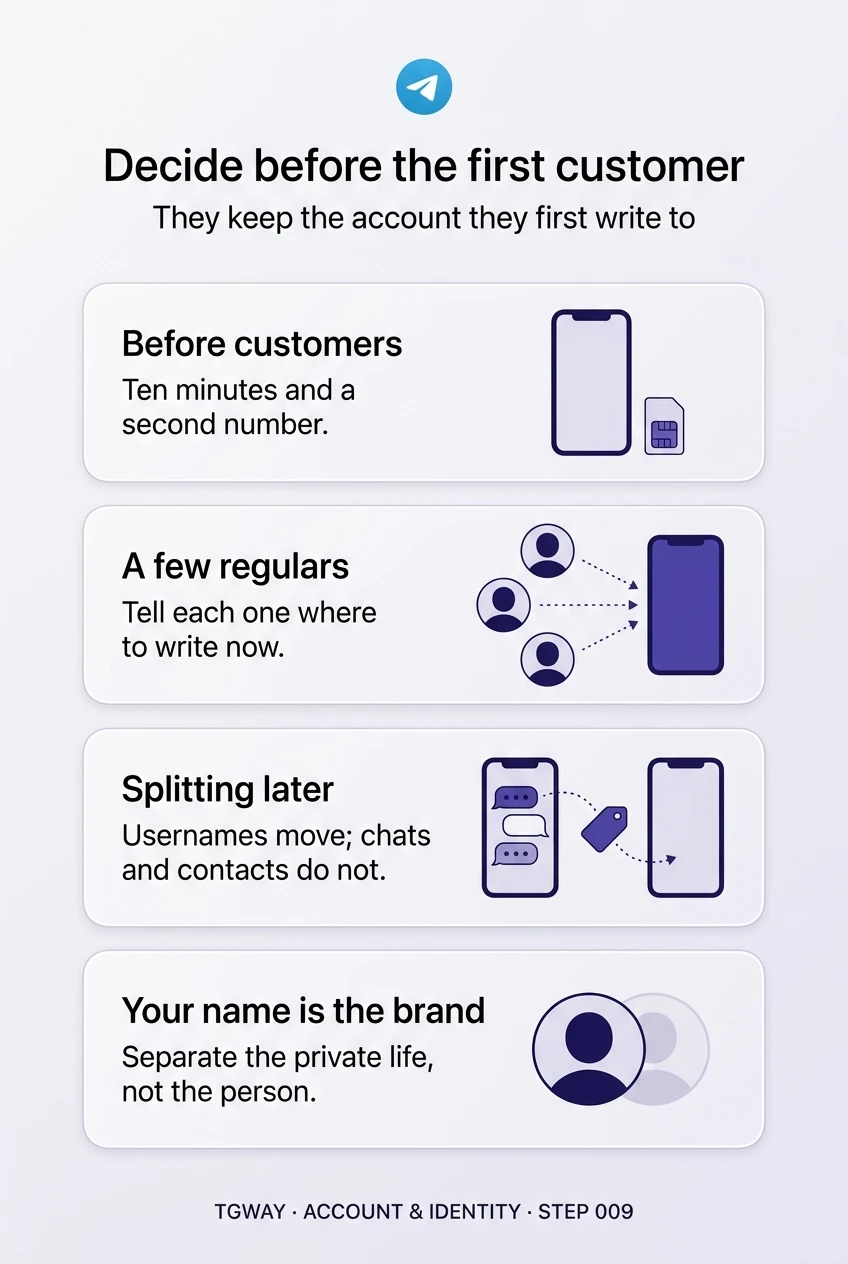
If the business is meant to grow, set up the separate account now, before anyone has your personal one. It costs a phone number and ten minutes. Every future customer meets the business profile first, and your personal account stays for people you know.
If it is a one-off side job that will never have more than a few clients, a single account is fine. Just be honest with yourself about which it is.
If in doubt, start separate. It is far easier than splitting later.
A few regulars already write to your personal account
Moving now is still easy. Create the business account, send each regular one short message from it saying this is where to reach you from now on, and reply to new work only from there.
A handful of people can be told personally. At this size, most will switch within a week.
Tell them one by one, while you still can.
Hundreds of customers know your personal profile
Splitting is still possible, but it is a gradual move, not a switch. Set up the business account, announce it wherever customers find you, and add a line to your personal bio pointing to it. Expect some customers to keep writing to the old account for a long time.
Meanwhile, tighten the personal account's privacy so customers see only what a customer should: profile photos, bio, last seen and stories.
Point the way, and accept a long overlap.
You are the business: a coach, an artist, a consultant
Here a separate account can feel artificial, because customers come for you. The usual compromise is one public-facing account with your professional name and photo, and a private account for family and close friends that customers never see.
The public account is still the business account. It is the one that gets Business features and a careful profile.
Separate the private life, not the person.
checklist What a business account needs before its first message
- Its own phone number. Every Telegram account is tied to one number, so a second account needs a second number, such as another SIM or an eSIM. Keep that number active; it is the account's root, as the Privacy & Security track explains.
- A room in your app. One app holds up to three accounts. Step 006 shows how to add one.
- The baseline. Two-Step Verification and a recovery email from day one. A business account is a more attractive target than a personal one.
- A profile a customer can read. Business name, a clear photo, a bio that says what you do, and a username you will not want to change.
- Business features, if you want them. Opening hours, a location, greeting and away messages and quick replies come with Telegram Business, which is part of a Telegram Premium subscription on that account.
- Notifications set apart. Its own sound, so you know which account is calling, as Step 008 described.
table_chart If you split later: what moves and what stays
This is why the timing matters. Accounts are separate things, and very little crosses between them.
| Item | Moves to the new account? | What to do |
|---|---|---|
| Chats with customers | No | They stay in the personal account. Start fresh threads from the business account. |
| A public username | Yes, with care | Remove it from the personal account and set it on the business one straight away; while it is free, anyone can take it. |
| Customers who saved you as a contact | No | Their contact still points to your personal number. Ask them to save the new account. |
| Groups and channels you own | Only by transfer | Add the business account as an admin, then transfer ownership, as the Group Ops track explains. |
| Business settings | No | Hours, greetings and quick replies are set again on the new account. |
quiz Which would you do?
You are about to post your first advert for a new online shop. What is the best time to create a business account?
The advert decides which account customers meet first, and that is the one they will save and share. Creating the business account now costs a number and a few minutes; later it costs telling everyone.
You move your public username from your personal account to the new business one. What should you avoid?
A released username is free for anyone to claim, including someone who wants to impersonate your business. Have the business account open and set the username the moment you remove it.
After you split, a long-time customer keeps writing to your personal account. What is the kindest fix?
Answering from the business account moves the conversation without punishing a loyal customer. Most people switch once they get a reply from the new place.
task_alt
touch_app Try it now — five minutes
- Count who writes to you about work None, a handful, or many. That tells you which tab above is yours.
- Check you have a second number If you plan a business account, decide which SIM or eSIM will carry it, and that you will keep it.
- Write the one message If you already have customers, draft the short note that tells them where to write from now on.
Why Business is a switch on the account you already use, not a separate app, why that puts your address and hours on your personal profile, and why separation means a second account, decided before customers arrive.
help Questions
Can I turn my personal account into a business account?
You can add Business features to it, which is what many sole traders do. But it stays the same account, with the same history, contacts and profile. If you want your private life out of view, that takes a second account, not a setting.
Do I need Premium for a business account?
Not for the account itself. A second account is free, like any account. Premium is needed only if you want the Telegram Business features on it, such as hours, greetings and quick replies.
Can several employees use one business account?
They can each sign in to it, but every reply then comes from the same name, and everyone signed in can read every chat. For more than two or three people, a support setup where replies are routed and signed is usually better; the Business track covers the options.
Should the business account use my real name?
Use the name customers know you by. For a shop, that is the shop's name. For a freelancer, a professional version of your own name works, with a photo you are happy for strangers to see.
Decide before the first customer
When a separate business account is worth it at each stage, what it needs before its first message, and what does and does not move if you split later. Tap to open it at full resolution.