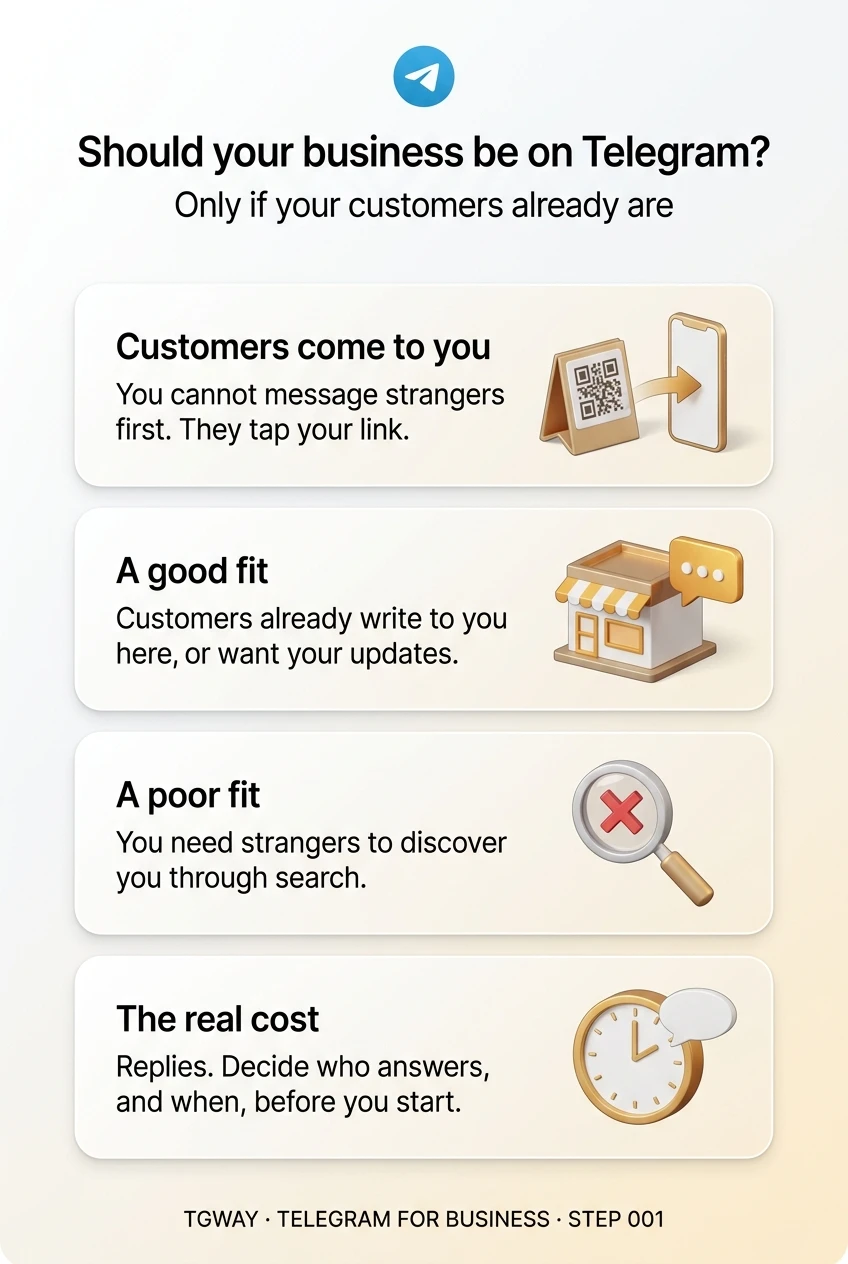
Should Your Business Use Telegram?

Most advice about using Telegram for business starts with its features: channels with unlimited subscribers, bots, payments, a set of business tools inside Premium. All of that is real. None of it matters if your customers do not already open Telegram every day.
A messaging app is not a shop window that strangers walk past. People only see you there if they came looking, and they only come looking if the app is already part of their day. So the first question is not what Telegram can do for you. It is whether your customers are already there. This track assumes the answer is yes, and this step helps you check it honestly before you build anything.
What you will be able to do after this step
- check_circle Tell whether your customers are likely to reach you on Telegram.
- check_circle Name the kinds of business Telegram suits well and poorly.
- check_circle Run a small test before committing time to it.
how_to_reg Customers come to you, not the other way round
This is the single fact that shapes everything else in this track. On Telegram, a business cannot simply message people who have never contacted it. Bots cannot start conversations, and accounts that write to many strangers are quickly limited as spam. The conversation starts when the customer taps your link, scans your code or finds your username.
That is good for customers, and it changes the business question. You are not buying reach; you are giving people who already know you a better way to stay in touch. If you have no other way to be found yet — no shop, no website, no following elsewhere — Telegram will not find customers for you. It will look after the ones you already have.
Where Telegram fits, and where it does not
These are patterns, not rules. A business can sit on both sides, which usually means Telegram suits one part of it.
trending_up Good fit
trending_down Poor fit
Telegram is a relationship tool, not a discovery tool. It rewards businesses whose customers are already nearby and punishes those hoping it will bring them.
schedule The cost nobody puts in the plan
Setting up a channel or a business account is free and quick. The real cost is replies. Once customers can reach you in the app they use every day, they will, and they expect a messaging app to answer like a messaging app: in minutes or hours, not days.
An unanswered message on Telegram feels worse to the customer than an unanswered email, because the app shows them it was delivered and often that it was read. Before you commit, decide who answers, when, and what they say outside those hours. The Business tools in Telegram Premium help here — opening hours, an automatic away message, saved replies — but they only work if a person reliably turns up afterwards.
If you cannot answer, a channel you publish to without taking questions can still be worth having. Just say plainly where questions should go instead.
science A one-week test before you build
- Ask ten real customers "If I posted updates somewhere, where would you actually read them?" Count the answers. If Telegram is not in the top two, stop here or keep it small.
- Look at where people already reach you Check your inbox, your phone and your other apps for the last month. If some customers already write to you on Telegram, that is your strongest signal.
- Put one link where customers already are A line on your receipt, your website or your shop counter with your Telegram username. Watch who uses it for a week.
- Time your replies Answer every message that arrives during the test and note how long it took. That is the service you are actually able to offer.
Three businesses, one question each
Tap what you would tell each owner.
A bakery's regulars already ask on Telegram whether today's bread is ready. The owner wants a way to stop answering the same question twenty times.
The customers are already there and they want the same update. One post a morning replaces twenty replies, and nothing more complicated is needed yet.
A new online shop has no customers yet and hopes to find them by creating a Telegram channel.
An empty channel is found by almost nobody. And messaging strangers in groups is the fastest way to be limited as spam. The channel becomes useful once customers exist to follow it.
A consultant's clients all use another messenger, but the consultant prefers Telegram.
Asking customers to change apps for you is friction you pay for in lost messages. Telegram can still serve the clients who already live there.
task_alt
explore What this track covers next
If the test says yes, the next steps choose your front door — a personal account, a channel, a group, a bot or a mini app — and then separate the business from your personal account before the first customer arrives. After that come trust, replies, selling, payments and support, each built on the assumption you have just checked: that your customers came to you.
Opening hours, greetings, away messages and saved replies, and why they attach to the account you already use rather than creating a separate one.
help Questions
Can my business send messages to customers who have not contacted me?
Not in the way an email list or SMS campaign can. Bots only reply to people who started them, and personal or business accounts that message many strangers are limited as spam. Customers need to join your channel, start your bot or write to you first.
Do I need Telegram Premium to use Telegram for business?
No. Channels, groups and bots are free. The Business tools, such as opening hours, greeting and away messages, saved replies and connecting a bot to your chats, are part of Premium. Many small businesses start without them and add them when replies become a burden.
Can customers find my channel through Telegram search?
Public channels can be found by name and username, and people already searching for you will find you. What Telegram does not do is recommend your channel to strangers the way a marketplace or a social feed might. Treat search as a way for existing customers to find you, not a way to be discovered.
Is it worth being on Telegram "just in case"?
Reserving your business's username is cheap and sensible, so nobody else takes it. Running an unattended channel or account is not: a presence that does not answer tells customers you are not really there.
Should your business be on Telegram?
The one fact that decides it, where Telegram fits and where it does not, and the cost nobody plans for. Tap to open it at full resolution.