Check Existing Telegram Groups Before You Start One

Before you open a room, somebody else has usually opened one for the same people. It might be busy, it might be half asleep, it might be run in a language or a tone you would change. Either way, your new room will not arrive in empty space. It will arrive next to that one, and the people you want are already choosing where to spend their attention.
This step is a short piece of homework with a clear finish line. If you cannot write, in one line, what your room will do that the existing one does not, the right move is to join it. If you can, you have also written the first sentence of your description, which is where Step 005 picks up.
What you will be able to do after this step
- check_circle Find the rooms that already serve your audience, in about twenty minutes.
- check_circle Tell a room that is genuinely alive from one that only has a large member count.
- check_circle Write the one-line difference, or decide honestly that there is none.
call_split Why a second room can hurt both
Conversation does not add up across rooms; it divides. When the same forty people are split between two groups, each group gets half the questions, half the answers and half the reasons to open it. The quieter of the two starts to look abandoned, members drift to the other, and the one that was already there loses some of its regulars in the process. Nobody gains, and the newcomer who asks a question now has to guess which room will answer.
That is why this check comes before any settings. It is not about being polite to other admins. It is about whether your room will have enough conversation to survive, and whether the people you are building it for are better served by one strong room than by two weak ones.
travel_explore Where to look
Twenty minutes across these places will find most of what exists. Keep a short list as you go: the room's name, its link, and one note about what it is really used for.
- Telegram's own search. Type the words your members would use, not the words you would put in a title. Public groups and channels appear in the results by name and username. Try the plain topic, your city or region, and the name of the product, club or course involved.
- Recommendations on channels you already follow. A channel's page can suggest similar channels, based on which channels the same people read. It only finds more of the same, which is exactly what you want here.
- The people themselves. Ask three people from your intended audience where they already talk about this. Private groups never show up in search, and they are often the ones that matter most.
- Outside Telegram. Search the web for your topic together with the words "Telegram group" or "Telegram channel". Public rooms are linked from websites, forums and directories, and public channels can be read on the web without the app.
query_stats Reading a room you found
Member counts are the least useful number on a room's page. A group can hold thousands of people who joined years ago and have not opened it since. Spend two minutes inside each candidate and look at these instead.
| What to check | How to check it | What it tells you |
|---|---|---|
| When people last spoke | Scroll to the latest messages and look at the dates | A room whose last real conversation was months ago is a gap you can fill, not a neighbour you compete with. |
| How many different people talk | Count the names in the last day or week of messages | Ten active voices matter more than ten thousand members. One person posting alone is a noticeboard, not a community. |
| Whether questions get answered | Find a recent question and see what came after it | Unanswered questions are the clearest sign that the room has lost its helpers. |
| Whether anyone moderates | Look for spam that has stayed up, and at the pinned message | Spam left overnight and an old pinned post mean nobody holds the keys day to day. |
| Who it is really for | Read the description, then compare it with what people actually post | The stated audience and the real one often differ. Yours may be the real gap. |
| Language and tone | Read ten messages in a row | A room in another language, or at a different level, may serve a different audience entirely. |
A difference that justifies a room, and one that does not
Write the line as: "The existing room does this. Mine will do that, for these people."
task_alt Differences that hold up
A different audience: another language, another city, beginners instead of experts.
A different job: announcements only, where the existing room is open chat, or the reverse.
A different rule that members want: no promotion, or questions only, in a topic where the existing room allows everything.
The existing room is gone: months of silence, unanswered questions, spam nobody removes.
cancel Differences that do not
"Mine will be better", with nothing specific about what better means.
"Mine will be mine", when the real reason is wanting to be the admin.
A different name or logo for the same people and the same conversation.
"More active", about a room that is in fact active, just not in the way you would run it.
A real difference names who or what changes. If your line only names you, join the existing room.
alt_route What joining can look like
"Join instead" does not have to mean giving up on what you wanted to build. It usually means building it where the people already are:
- Become a regular first. Answer questions for a few weeks. Admins notice the people who help, and many rooms are short of exactly that.
- Offer to help run it. A room with unanswered questions and overnight spam often needs a second moderator more than it needs a competitor.
- Propose a topic inside it. If the group uses topics, your subject may fit as one thread rather than as a new room, with none of the work of starting from zero.
- Build the complement. A channel that summarises the best of a busy group each week, and links back to it, serves both rooms instead of splitting them.
And if the one-line test passes, you are not taking anything from the existing room. You are serving people it was not serving. Say so plainly in your description, and link to the other room when a question belongs there; the goodwill tends to come back.
edit_note Try it now — twenty minutes
- Search three ways In Telegram's search, try the plain topic, your topic with your city or language, and the name of the thing your members share. Note every public group or channel that matches.
- Ask three people Message three people from your audience: "Where do you already talk about this on Telegram?" Add any private rooms they mention.
- Read the top three Open the three most relevant rooms and go through the table above. Two minutes each is enough.
- Write the line "The existing room does this. Mine will do that, for these people." Save it in your Saved Messages next to the three sentences from Step 001. If you cannot finish it, join the best room on your list today.
How global search finds public groups and channels, how to narrow results, and what search will never find, including every private room.
help Questions
Why can I not find private groups in search?
Private groups and channels have no public address, so search does not list them. The only way to learn about them is from people who are in them, which is why asking your audience is part of the homework. The rooms that serve a community best are often private for exactly that reason.
The existing room is huge. Does that mean mine has no chance?
Not by itself. Size is the least reliable signal on the page. Look at how many different people spoke this week and whether questions are answered. A large, quiet room with unanswered questions leaves plenty of space for a smaller one that actually replies.
Is it rude to open a room next to someone else's?
Not if it serves people the other room does not. It becomes a problem when it copies the same room for the same people and pulls members away. Linking to the other room for questions that belong there, and saying clearly what yours is for, keeps relations friendly.
Should I ask the other admin before I start?
It is often worth a short message, especially in a small community. You may learn that they have wanted a second moderator, or a language section, or a summary channel. Sometimes the conversation turns your new room into a part of theirs, which is usually the better outcome for members.
What if the only existing room is full of spam?
That is one of the strongest reasons to start your own, and one of the easiest lines to write: "The existing room is unmoderated; mine will be looked after every day." It also tells you what your room will be judged on, so plan the moderation hours before you launch. Step 008 covers that.
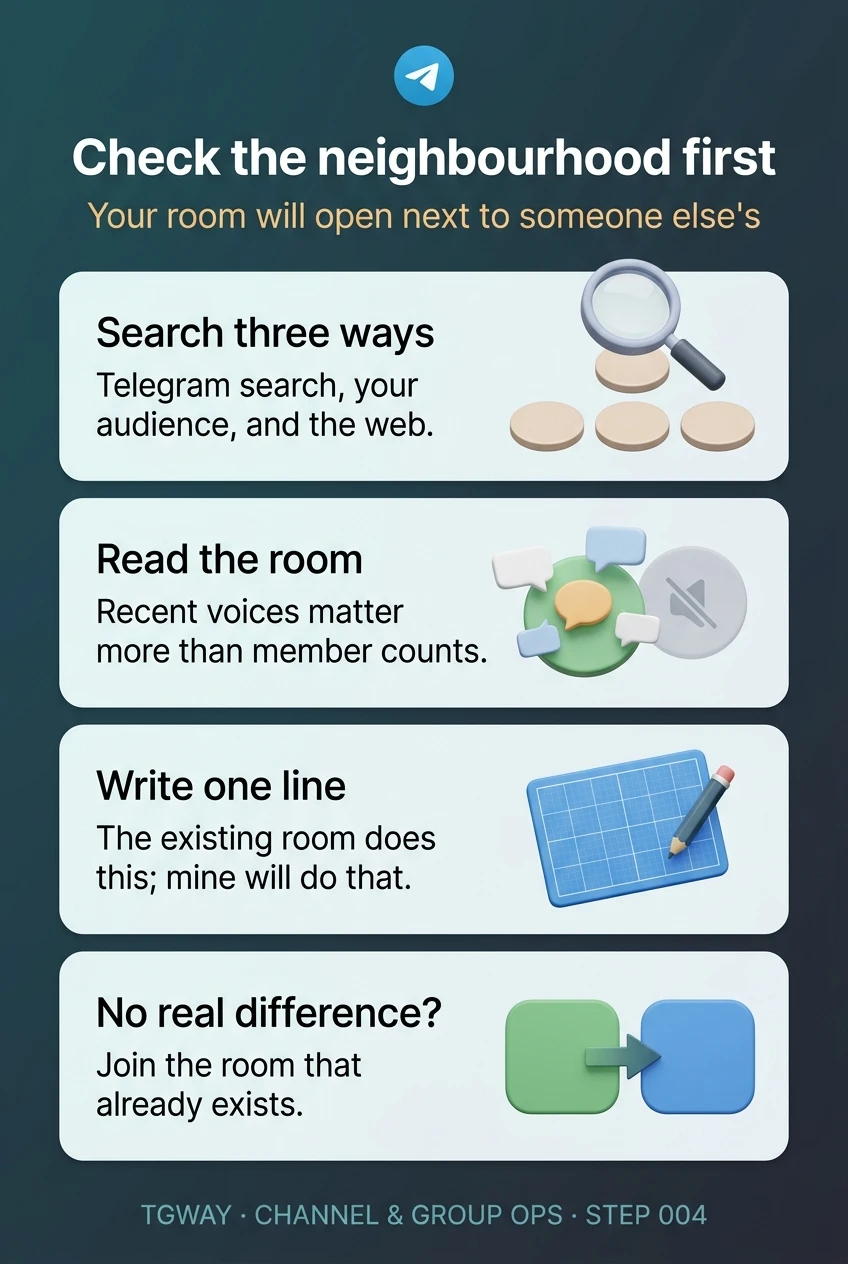
Check the neighbourhood first
Where to look for rooms that already serve your audience, how to read them, and the one-line test that decides between starting and joining. Tap to open it at full resolution.