Three Rules to Set Before Your Telegram Group Opens

Most group rules are written as a long list the night before launch: no spam, no insults, no advertising, no politics, no off-topic, respect everyone, English only, and five more. The list gets pinned, nobody reads past the third line, and the first person who breaks a rule is almost never the person it was written for.
People who mean harm do not read rules. The people rules actually reach are ordinary members who mean well and do something the room did not want, because nobody told them. So the useful rules are the ones a well-meaning newcomer would break by accident, and there are rarely more than three of them. This step shows how to find your three before the first member arrives, and how to keep everything else out of the rule list.
What you will be able to do after this step
- check_circle Tell a rule that needs writing from one a setting can enforce for you.
- check_circle Pick the three accidental mistakes your room is most likely to see.
- check_circle Write each rule so a newcomer knows what to do instead.
tune Settings first, rules second
Anything a setting can enforce should not be a written rule. A setting works at three in the morning, applies to everyone the same way, and never needs an argument. A written rule only works if someone reads it and agrees with it.
- Links and media from newcomers. Group permissions decide what members can send. Limiting links and media is a setting, not a sentence.
- Floods of messages. Slow mode spaces out how often each member can post.
- Who gets in. Join requests let admins approve new members before they can read or write.
- Obvious spam. Automatic filters and moderators handle it. A rule saying "no spam" changes nothing, because no spammer thinks the rule is about them.
Once those are set, what is left for the written list is behaviour that needs judgement: what belongs in this room, how to ask, how to treat other members. That is where the three rules come from.
Where accidental rule breaking comes from
Almost every good-faith mistake in a group falls into one of these. Your three rules usually come from the two that fit your room best.
A newcomer does not know where the edge of the topic is
A group about a camera brand gets asked about phones. A group for a local football club gets job adverts from members who just want to help. Nobody thinks they are off topic; they think they are being useful.
A good rule draws the edge with an example: "Questions about the X100 and its lenses. For other cameras, try our sister group." It tells the person what to do next, which is what turns a correction into help.
Name the edge with one example of what is out, and where it can go instead.
What feels normal in a private chat is noise in a group
Ten one-line messages in a row, long voice messages, photos of a screen instead of the text, a full article pasted as a wall. In a chat between two friends these are fine. In a room of four hundred people they bury everything else.
A rule here is a matter of form, not manners: "Please write your question in one message, as text. Voice messages are hard for most members to follow." Give the reason in a few words; people follow a rule they understand.
A rule about form works best when it says why the room is different from a private chat.
Members do not know that messaging each other privately is unwelcome
Someone answers a question in the group, and another member writes to them privately to continue, or to offer a service. The first message may be kind. The fifth person who does it is a problem, and members who get unwanted private messages often leave without saying why.
This one cannot be enforced by a setting, which is why it belongs on the list: "Ask before you message a member privately. Report anyone who contacts you uninvited." It also warns members about the scam accounts that do exactly this.
A rule that no setting can enforce is the one most worth writing down.
The same question arrives every day, often by tagging an admin
Newcomers ask what has already been answered, and they ask the person whose name they can see, usually the owner. Neither is rude. Both wear out the people who run the room.
A rule about asking points to where answers already are: "Check the pinned message first. If it is not there, ask the group, not a specific admin." Combined with a pinned list of the five most common answers, it removes most repeat questions.
A rule about asking only works if the answers are actually pinned.
edit_note How to write one rule
Each of your three rules should have three parts, in one or two short sentences.
- The behaviour, not the value. "Be respectful" is a value everyone thinks they already hold. "No replies that are only an insult or a laughing sticker" is behaviour someone can recognise in their own message.
- The reason, in a few words. "Because most members read on their phones" is enough. A rule with a reason gets followed; a rule without one gets argued with.
- What to do instead. Where the question goes, which topic to use, who to ask. A rule that only says no leaves the newcomer stuck.
Put the rule people break most at the top. It is the only one everyone will read.
quiz Rule, setting or neither?
New members keep posting links to their own shops in their first message. What handles it best?
A permission stops the link before anyone sees it, at any hour, without a moderator. Someone who posts a shop link in their first message has not read the rules and will not start. Save the rule list for behaviour that needs judgement.
Members keep writing privately to people who answer questions in the group. What handles it best?
No setting stops one member messaging another they can already see in the chat, and hiding the member list does not hide people who post. It is exactly the kind of well-meant habit a written rule is for, and it doubles as a warning about scam accounts.
Your draft list says "No spam, no scams, no bots". What is it worth?
Spammers and scammers do not read or obey rules, and ordinary members already agree. Join requests, permissions, filters and moderators do this work. The top of the list is the most-read line in the room; give it to a mistake a real member would make.
task_alt
push_pin Where the three rules live
The same three rules should appear in the places a newcomer actually looks, in the same words. The description from Step 005 can carry the most important one in a single line. A pinned message holds all three, with the pinned answers underneath. A welcome message, if you use one, repeats the top rule to each person as they join.
After the first month, look at what your moderators actually had to correct. If a rule on the list was never broken, it can go. If the same mistake keeps coming up and it is not on the list, it replaces the weakest rule. The list stays at three because a fourth rule makes the first one less likely to be read.
touch_app Try it now — fifteen minutes
- Move everything a setting can do into settings Go through your draft list. For each line, ask whether a permission, slow mode, join requests or a filter could enforce it. If so, set it and delete the line.
- Imagine a friendly newcomer Picture someone who likes the topic and has never been in a group like yours. Write down the three things they would most likely do wrong in their first week.
- Write each as behaviour, reason and alternative One or two short sentences each. Read them aloud; if a rule sounds like a warning to criminals, rewrite it for a friend.
- Pin them, and put the top one in the description Same words in every place, with the most-broken rule first.
Why a welcome card works where a pinned list does not, the three things a good one says, and why it must never ask a newcomer for anything.
help Questions
Is three rules really enough for a large group?
For the written list, usually yes. Large groups need more enforcement, not more rules: more moderators, stricter permissions, join requests. A long list does not protect a big room; it just means members skip it. If you need more, put the details in a linked page and keep three at the top.
Should the rules say what happens when someone breaks them?
A single line is enough, such as "Moderators may remove messages and members who ignore these rules." The detail of warnings and removals belongs to how your moderators work, which a later step in this track covers, and it matters more that they act consistently than that the steps are written out.
What about a language rule?
If your room uses one language, it is often one of the three, because newcomers genuinely do not know. Say it in that language and, where it helps, in the language people most often write in by mistake.
Do channels need rules too?
A channel only has posts from its admins, so there is nothing for subscribers to break. If the channel has a discussion group for comments, that group needs its three rules, written in the channel where subscribers will see them.
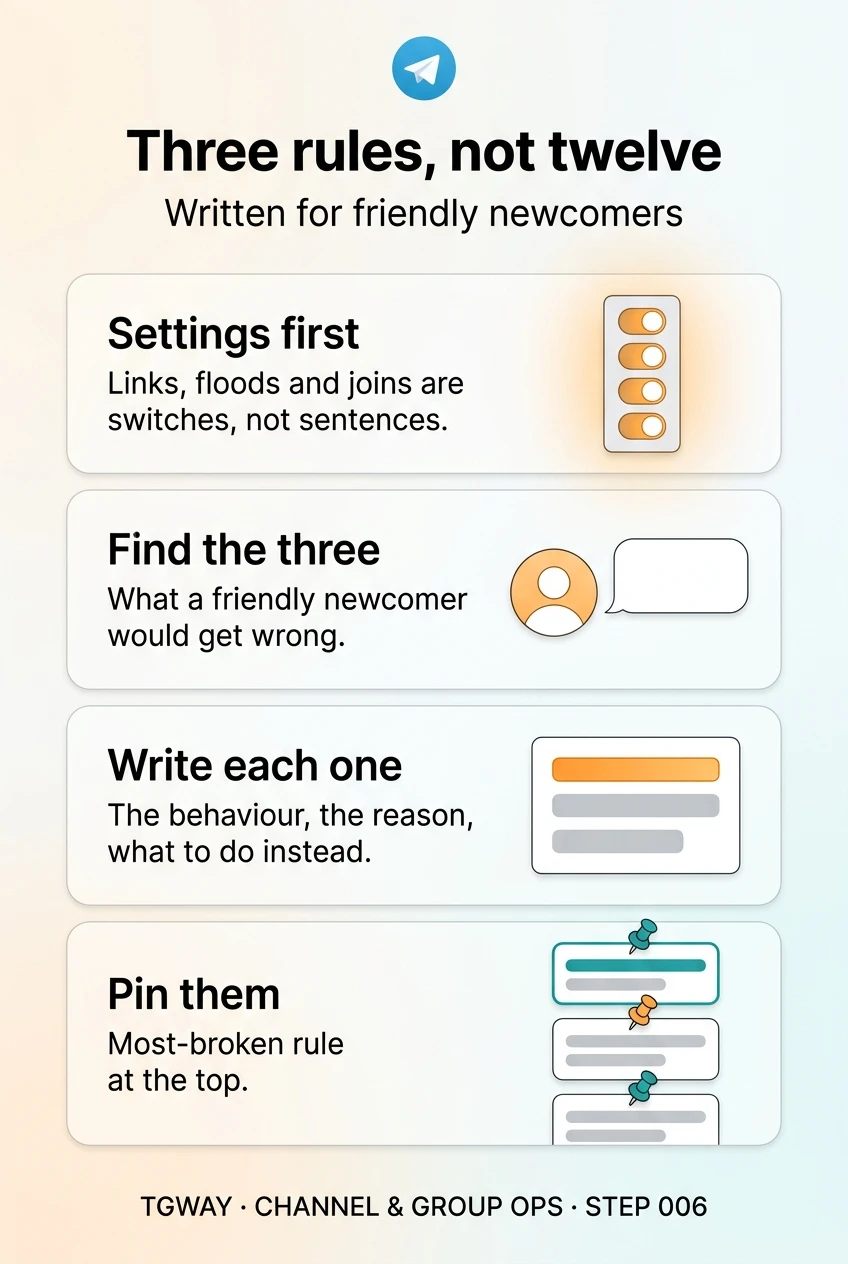
Three rules, not twelve
Settings first, then the three mistakes a friendly newcomer would make, written as behaviour, reason and what to do instead. Tap to open it at full resolution.