Send a Small Test Transaction Before the Real One

When people imagine losing crypto, they imagine a scam or a hack. In practice, a great deal is lost in a quieter way: a transfer to an address that was almost right, a deposit to an exchange without the comment it needed, a payment sent to the wrong network. Nobody stole anything. The coins simply went somewhere they cannot come back from.
The habit that prevents most of it costs one small network fee: send a little first, confirm it arrived, then send the rest. This step explains what a test transaction proves, what it does not, and how to do one properly with Gram, the coin formerly called Toncoin, or any token on TON. It says nothing about what to buy or hold; this is about moving what you already have without losing it on the way.
What you will be able to do after this step
- check_circle Do a test transfer and confirm, on the receiving side, that it arrived.
- check_circle Know which mistakes a test catches and which it cannot.
- check_circle Decide when a test is worth its fee and when you can skip it.
undo Why there is no second chance
A transfer on a blockchain is not a request that a bank can reverse. Once the network accepts it, it is final. There is no chargeback, no dispute form and no customer service that can pull it back, and if the address belongs to nobody, or to someone who will not return it, the coins are gone.
That is also why the small test works so well. It turns an irreversible action into two steps, and the first one is cheap enough to lose.
Moving your balance to an exchange
The exchange's deposit screen shows an address and a comment you must include.
send All at once
You paste the address and send the full amount.
You forgot the comment, so the exchange cannot tell the deposit is yours.
The whole balance now depends on a support ticket, if the exchange can help at all.
fact_check Small first
You send a small amount with the address and comment.
You wait until it shows on the exchange's side, credited to your account.
Only then do you send the rest, copying the same details again.
A test costs one extra fee. Skipping it can cost everything you meant to send.
table_chart What a test proves, and what it does not
| Mistake | Does a test catch it? | Why |
|---|---|---|
| A mistyped or badly pasted address | Yes | The small amount goes to the same wrong place, and never arrives where you expected |
| A missing or wrong comment for an exchange | Yes | The deposit arrives but is not credited to you |
| Sending on a network the recipient does not support | Yes | The recipient never sees it on their side |
| The recipient's minimum deposit | Only if the test is above it | Many exchanges ignore deposits below a minimum; check it before choosing your test amount |
| A dishonest recipient | No | A scammer will happily confirm your test and wait for the rest |
| The address changing between test and final | No | If you copy it again from the wrong place, the test proved nothing about the new copy |
The last two rows are why the test is a check on mechanics, not on trust. It tells you the pipe works. It does not tell you who is at the other end.
touch_app How to do it properly
- Get the address from the source The recipient's own receive screen, or the exchange's deposit page. Never from your transaction history, where a lookalike address may be waiting, as Step 005 explained.
- Check the recipient's minimum and comment If it is an exchange, note the minimum deposit and whether a comment or memo is required.
- Send a small amount Just above any minimum, with the comment if one is needed. Compare the first and last characters on the confirmation screen before approving.
- Confirm on the receiving side Not in your wallet, which only shows that it left. Ask the person, or check the exchange balance, until it shows as received.
- Send the rest the same way Copy the address and comment again from the same source, and compare the characters again. Do not assume the clipboard still holds the right thing.
quiz Is a test worth it here?
Your wallet shows your test transfer as sent. Can you now send the rest?
Your wallet can only tell you the coins left. The point of the test is to learn whether they landed where they should, credited to the right person or account. That answer comes from the receiving side.
A buyer you met online asks you to send a small test payment "to make sure everything works". Should you?
A test is a check you run on your own transfer, not a sign of trust. When a stranger asks you to send them money as a "test", that is usually the first step of a scam that ends with a larger payment.
You send the same friend a small amount every week, to the same address you saved in your contacts. Do you need a test each time?
A test proves a route once. For a small, repeated transfer to an address you saved yourself, the fee of a test each time adds little. Keep comparing the ends, and test again if they give you a new address or the amount becomes one you would mind losing.
task_alt
rule When to test
- Always for a new address, a first deposit to any exchange, or any amount you would mind losing.
- Always when a comment or memo is involved, because that is the most common silent failure.
- Again whenever the recipient gives you a new address, even a person you know.
- Optional for small, repeated transfers to an address you saved yourself and have already tested.
Custodial and self-custody wallets, why there is no chargeback or dispute process, the difference between connecting a wallet and approving a transaction, and why the most common loss is a mistaken address.
help Questions
How small should the test be?
Small enough that losing it would not matter to you, and large enough to clear any minimum the recipient has. The network fee is paid on top, so a test always costs a little more than the amount itself.
I sent everything to the wrong address. Can anyone help?
Nobody can reverse it. If the address belongs to an exchange or a service, their support may be able to help with a deposit that lacked a comment. If it belongs to a stranger, only they can send it back. Be wary of anyone who contacts you offering to "recover" it for a fee; that is a common second scam.
Does a test make a transfer safe from scams?
No. It checks the mechanics of your transfer. It says nothing about whether the person or site you are paying is honest. That judgement is yours, and later steps in this track cover the common scams.
Can I cancel a transfer while it is pending?
Once you approve it in your wallet, you should assume it will go through. There is no reliable way to stop it. The moment to check is the confirmation screen, before you approve.
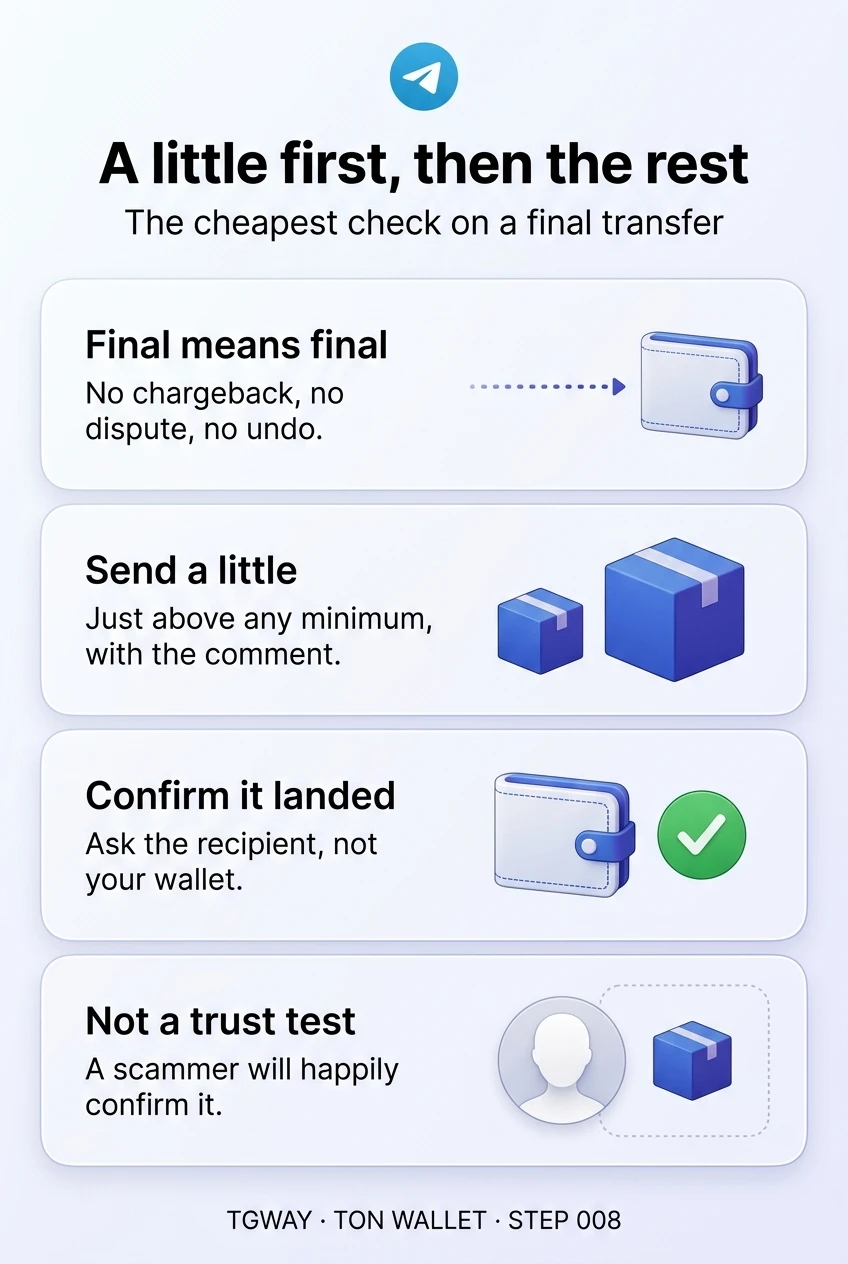
A little first, then the rest
Why a transfer on TON cannot be undone, what a small test catches and what it cannot, and how to confirm it landed before sending the rest. Tap to open it at full resolution.