How a Small Business Builds Trust on Telegram

Your customers have seen fake shops on Telegram, or heard about them. Before they send a first message, many of them are quietly asking one question: is this the real business, or someone who copied its name and photo? Big brands answer it with a verification check next to their name. A bakery, a tutor or a repair shop usually will not have one.
That is not the disadvantage it seems. The strongest trust signal a small business has is a link between Telegram and a place customers already trust: your website, your shop window, the listing they found you on. When each side points to the other, a customer can check you for themselves in seconds, which a badge alone never lets them do. This step sets up those signals and the habits that keep them believable.
What you will be able to do after this step
- check_circle Explain what the marks next to account names do and do not mean.
- check_circle Set up two-way links so customers can confirm your account from somewhere they trust.
- check_circle Tell customers, in advance, what your business will never ask them for.
verified What badges do, and why you probably will not have one
Telegram's own verification check is given to a limited set of well-known accounts, and it cannot be bought. A Telegram Premium or Business subscription adds features, not verification; the small badge a subscriber may show says they pay for the service, not who they are. Some organisations can also verify accounts through Telegram and show their own mark, which tells you who issued it when you tap it.
For a small business, the honest position is that most customers will never see a mark next to your name, and impersonators will not either. What separates you from a copy is everything a copy cannot fake: the places you have been for years, and the people who already know where to find you.
Trust signals a small business controls
None of these costs anything. Together they let a customer check you without asking you.
Your website points to Telegram, and Telegram points back
Put a link to your Telegram account on the places customers already trust: your website's contact page, your listing on a maps or review site, your other social profiles, a sign in the shop. Then point back from Telegram: your website in your bio, or in the description of your business channel.
The point is the direction of the check. A customer who starts from your website and taps the link lands on the real account, whatever lookalikes exist. Anyone can copy a profile photo; nobody can copy your website linking to them.
The link from a place they already trust is worth more than any mark next to your name.
One account, named the same everywhere
Use a single business account, and the same name, photo and username everywhere it appears. Step 004 set these up. When customers see the same handle on your receipt, your window and your website, a slightly different handle in a message stands out immediately.
Say it plainly somewhere visible, such as a pinned message in your channel or a line on your website: "We only use @yourhandle on Telegram." It gives careful customers a simple rule and gives you something to point to when an impersonator appears.
A customer who knows your one handle can spot every copy on their own.
Proof that you were here before today
Impersonators are almost always new. A business channel with months of ordinary posts, new stock, opening hours for the holidays, photos of real work, shows a history that a copy made last week cannot have.
The account itself carries history too. When someone who is not in your contacts writes to you, or you to them, Telegram shows details such as when the account joined. An account that has existed for years is harder to fake than a new one with the same photo.
A copy can borrow your name; it cannot borrow your past.
Tell customers what you will never ask
Most scams that use a business's name follow the same few moves: asking for payment to a new account, asking for a login code, asking the customer to "confirm" an order through a link. You can take those moves away by saying, publicly and in advance, what your business will never do.
A line such as "We never ask for codes, and we only take payment through the checkout on our website or at the counter" turns every unusual request into a warning sign your customers recognise. It costs one sentence and protects both of you.
A rule customers learned from you works even when you are not there.
gpp_maybe When someone copies you
If a business does well on Telegram, sooner or later someone may create an account with its name and photo and start messaging its customers. The signals above are what limit the damage, and a few quick steps handle the rest:
- Report the copy Open the impersonating account and report it for impersonation. Ask customers who received messages to do the same.
- Warn your customers where they will see it A short post in your channel and a line on your website: "An account copying our name is messaging people. We only use @yourhandle."
- Never answer the copy in public arguments Point people to your one handle and your website. A calm, repeated rule works better than a thread of accusations.
- Check your own account's security Sometimes a "copy" is actually your own account, taken over. Make sure Two-Step Verification is on and look at your device list. The Privacy & Security track covers this.
edit_note Try it now — fifteen minutes
- Add your Telegram link to your website and listings Your contact page, your maps or review listing, and your other social profiles. Use the link to your username, so it opens the real account directly.
- Add your website to your Telegram bio Or to your business channel's description. Now each side confirms the other.
- Write your "we never" sentence What you will never ask customers for, and how you do take payment. Put it on your website and pin it in your channel.
- Search for your own name In Telegram's search, look for your business name. If a copy already exists, report it now, before customers find it first.
The three kinds of mark that can appear next to a name, what each one says, and why tapping it to see who issued it is the only reliable check.
help Questions
Can my business apply for Telegram's verification check?
Telegram verifies a limited number of well-known accounts, and there is no public route for a small business to buy or simply request the check. Plan as if you will not have it. The signals in this step do more for a local business than a mark would, because customers can check them themselves.
Does subscribing to Telegram Business make my account look verified?
No. Business and Premium subscriptions add features such as opening hours and automatic replies. Any badge they show means the account subscribes, not that anyone has confirmed who you are. Do not describe it to customers as verification.
Should I put "Official" in my business name?
No. Words like "Official", or check marks typed into a name, are exactly what impersonators use, and careful customers are taught to distrust them. Your two-way links do the job properly.
A customer paid a fake account using my name. Is that my responsibility?
That depends on where you are and on the circumstances, and this track does not give legal advice. Practically, help the customer report the account, keep a record of what happened, and make your "we only use @yourhandle" and "we never ask" rules more visible so it does not happen again.
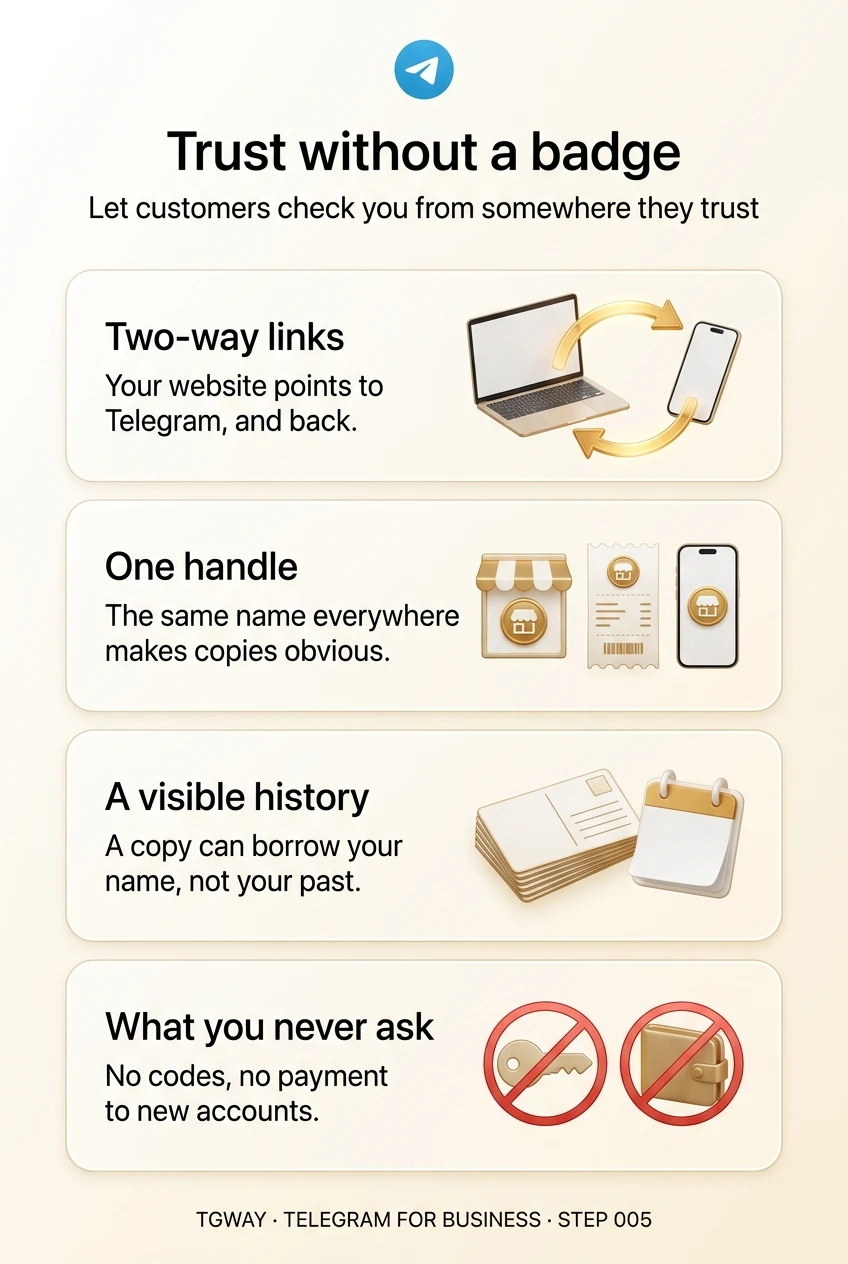
Trust without a badge
Two-way links, one handle, a visible history and a clear list of what you never ask: the trust signals a small business controls. Tap to open it at full resolution.