How a Business Gets Paid Through Telegram

Sooner or later a customer asks the question every business on Telegram meets: "How do I pay?" Many small sellers answer with a bank account number and ask for a screenshot of the transfer. It works, until the day a screenshot turns out to be fake, or a customer wants a refund and nobody can find the payment.
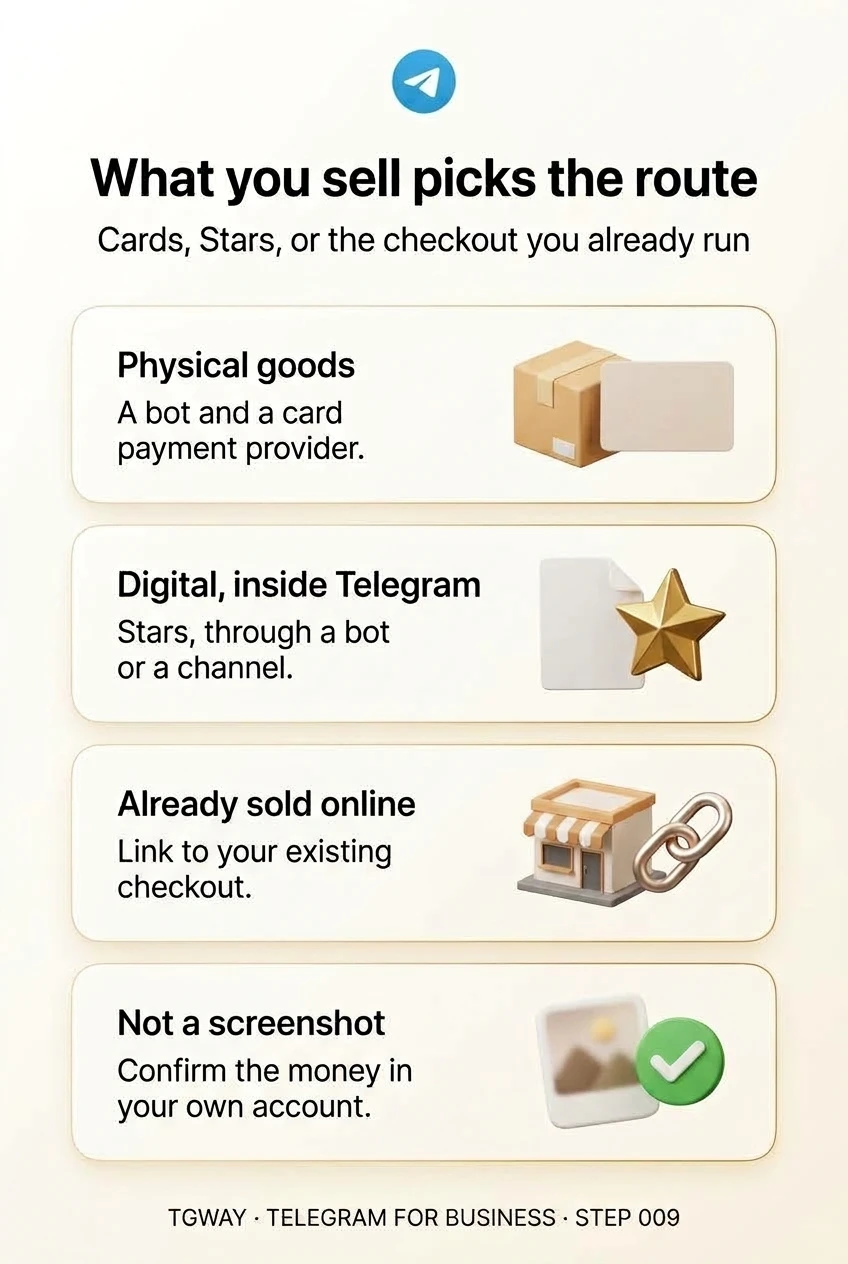
Which way you get paid is mostly decided by what you sell, not by what you prefer. Physical goods and services go through a card payment provider. Digital goods and services sold inside Telegram go through Stars. Everything else goes through a checkout you already run somewhere else. This step gives an overview of the three routes, what each asks of you, and why "send me a screenshot" is the weakest of all. It is not tax or legal advice; how you declare the income depends on where you trade.
What you will be able to do after this step
- check_circle Tell which payment route fits what you sell.
- check_circle Know what each route leaves you to handle yourself.
- check_circle Avoid the common trap of confirming payments from screenshots.
table_chart The three routes
| You sell | Route | The customer pays with | You still handle |
|---|---|---|---|
| Physical goods, or a service you perform in person | A bot connected to a card payment provider | A card, in a payment form that opens inside Telegram | An account with the provider, delivery, returns and refunds |
| Digital goods or services inside Telegram | Stars, through a bot, a mini app or a channel | Stars they already hold, or buy on the spot | Delivery, payment support, and withdrawing what you earn |
| Something you already sell on your own website | A link to your existing checkout | Whatever your checkout accepts | Everything your website already handles |
The line between the first two rows comes from the app stores, not from Telegram's taste: digital goods sold inside an app are expected to be paid through the platform. That is why Stars exist, as What Stars are explains, and why a bot selling an e-book is expected to take Stars rather than a card.
credit_card Cards for physical goods
Regular Telegram accounts cannot send invoices; bots can. You connect the bot to a supported payment provider, and when a customer orders, the bot sends an invoice. Tapping Pay opens a payment form inside Telegram, and the provider processes the card. You receive the money through your provider account, on the provider's terms.
If you use a Telegram Business account to talk to customers, you can still connect a bot to send the invoices. The conversation stays personal; the checkout becomes a real one, with a record on both sides.
star Stars for digital goods and content
Stars suit what Telegram itself delivers: a file from a bot, credits in a mini app, a paid post, a subscription to a private channel. The customer pays with a balance they already have, which removes the friction of a card form, and you receive Stars you can later withdraw under the rules shown to you when you do.
The cost of Stars is the other side of the same coin: purchases are generally final for the customer, so they judge you before paying, not after. And sellers are expected to answer payment problems themselves; bots that take Stars must respond to a /paysupport command.
A screenshot, or a checkout
A customer orders a handmade lamp through your chat.
photo_camera "Send me a screenshot"
You share your bank details in the chat, where they stay.
The customer sends a screenshot; you ship because it looks right.
A week later the transfer is not in your account. Screenshots are easy to fake.
For a refund, neither of you has a record beyond the chat.
receipt_long Through a checkout
A bot sends an invoice with the item and price.
The customer pays in Telegram's payment form; you are told when it succeeds.
You ship only after the payment is confirmed on your side.
Refunds follow the provider's process, with a record both of you can point to.
If you do take transfers, confirm them in your bank, never from a screenshot.
quiz Which route?
You sell downloadable sewing patterns through a bot. How should customers pay?
A pattern delivered by the bot is a digital good sold inside Telegram, which is what Stars are for. Card providers are for physical goods and services performed outside the app.
A customer sends a clear screenshot of a bank transfer. What do you do before shipping?
A screenshot is a picture, not a payment. Editing one takes seconds. The only confirmation is the money appearing in your own account.
You already run an online shop with its own checkout, and customers find you on Telegram. What is the simplest option?
A checkout you already run handles payment, receipts and refunds. Telegram can simply be where customers ask questions and get the link. Build a bot checkout later, if orders through chat grow.
task_alt
touch_app Try it now — ten minutes
- List what you sell Mark each item as physical, a service, or digital and delivered inside Telegram.
- Match each to a route Use the table. Most small shops end up with one main route and, at most, one other.
- Check how you confirm payments today If the answer is "a screenshot", start checking your own account before every shipment, from today.
- Remove old bank details from chats Where you posted them in a public group or channel, delete them and share them privately, only when needed.
Why digital goods use Stars and physical goods a card processor, the check a bot must answer quickly before a payment goes through, and why you deliver on confirmation, not on a promise.
help Questions
Does Telegram take a cut of card payments?
Card payments go through the provider you connect, and the provider's fees apply. Check them with the provider before you start. Stars are different: their value to you is set by the withdrawal rules shown when you withdraw, after the app stores' share has already been taken.
Can I take payments in crypto?
Some businesses accept transfers to a wallet, and the Wallet track covers how transfers work. Treat it like a bank transfer: final once sent, confirmed only when it appears in your own wallet, and with no card-style dispute process for either side.
Can I send an invoice from my own account instead of a bot?
Not from a regular account. Invoices come from bots. A Business account can connect a bot, so customers keep talking to you while the bot handles the payment step.
Is it safe to share my bank details in a chat?
Sharing them one to one with a customer who is paying is common, but they stay in that chat history, as Step 008 described. Never post them in a group or channel, and treat any message asking you to change where money should be sent as suspect until you confirm it another way.
What you sell picks the route
The three ways a business gets paid through Telegram, cards, Stars or an existing checkout, what each leaves you to handle, and why a screenshot is not a payment. Tap to open it at full resolution.