A 30-Day Plan for Launching a Business on Telegram

The first nine steps of this track each covered one decision: whether to be on Telegram, which front door to use, how to separate the business, what the profile says, how to earn trust, which promises to make, what to automate, how to handle customer data, and how to get paid. Read together, they are a lot. Done all at once, they are a week of evenings and a tired owner.
Most of those decisions do not need to be made on day one, and some are better made after a month of real customers. This step closes the first module with a thirty-day plan: what to set up before the first message, what to add as customers arrive, and what to deliberately leave until you know what your customers actually ask for.
What you will be able to do after this step
- check_circle Put the first nine steps in a sensible order for your launch.
- check_circle Tell what must be ready on day one from what can wait.
- check_circle Use the first month's real messages to decide what to add next.
The first month, week by week
Each week builds on the one before. Pick the week you are in.
Before anyone writes to you
Decide the front door, Step 002, and whether you need a separate account, Step 003. Set up that account with Two-Step Verification and a recovery email on day one.
Write the profile from Step 004: name, photo, a bio that says what you do, and a username you will not want to change. Add one trust signal from Step 005, such as a link from your website to this exact account.
By the end of week one, a customer could find you and know it is you.
Tell a small circle, and answer by hand
Share the account with people who already know you: existing customers, friends, your website. Answer every message yourself. This week is for learning what people actually ask.
Set hours only if you can keep them, as Step 006 explained. A clear line such as "I usually reply within a day" is better than opening hours you will break.
Answer by hand, and write down every question.
Make taking money boring and reliable
Pick the payment route from Step 009 that fits what you sell, and use it for every order. If you take transfers, confirm each one in your own account, never from a screenshot.
Decide where order details live outside the chat, as Step 008 suggested, so you are not searching conversations for addresses.
One payment route, one place for records.
Look at what the month taught you
Read back the questions you wrote down. The ones that came up five times are your quick replies and your greeting. The facts people always ask for are what, if anything, is worth automating, as Step 007 described.
Only now decide on the extras: Telegram Business features, a bot, a channel for announcements. You are choosing them for questions you have seen, not ones you imagined.
Automate what actually repeated.
table_chart Now, soon, or later
| Item | When | Why then |
|---|---|---|
| Separate business account and security baseline | Day one | Every customer after this meets the right account, and it is protected from the start |
| Profile, username and one trust signal | Week one | It is what the first customer checks before writing |
| A realistic reply-time promise | Week two | Once you know how quickly you actually answer |
| One payment route and a place for records | Week three | Before orders arrive faster than you can track them by memory |
| Quick replies and a greeting | Week four | Written from real questions, not guesses |
| A bot, automation or an announcement channel | After the first month | Only when a repeated need shows it would help |
quiz What comes first?
You are launching next week. Which should you set up first?
The account and its profile are what every customer touches from the first message, and they are hard to change later. Automation and channels are easier to add once you know what customers need.
After two weeks, the same question about delivery times has come up seven times. What now?
A question that repeats is exactly what quick replies and greetings are for. A full bot is a much bigger step, and one repeated question does not justify it.
You are tempted to announce opening hours of nine to nine, seven days a week. What is the risk?
A customer who writes during your "open" hours and gets no reply trusts you less than one who was told to expect an answer within a day. Promise what the first month shows you can deliver.
task_alt
do_not_disturb What to leave alone in the first month
Some things feel like progress but mostly add work before you have customers to justify it. Paid promotion sends strangers to an account that has not yet learned how to answer them. A group for customers needs someone to run it every day, as the Group Ops track shows. A bot built on guesses answers questions nobody asks. None of these is wrong; each is simply cheaper and better once the first month has shown you what people want. The one thing that should never wait is security: an account that customers trust with their messages and money needs the baseline from the first day.
touch_app Try it now — fifteen minutes
- Mark today as day one Put four weekly reminders in your calendar, one for each week above.
- Start a question log A note where every customer question goes, with a tally for repeats.
- Do week one today Account, security baseline, profile and one trust signal. Leave everything else for its week.
What Telegram Business adds to an account, why hours and quick replies come first and a connected bot comes last, and why separation is a second account decided before customers arrive.
help Questions
My business already has customers on Telegram. Is this plan still useful?
Yes, as a checklist. Go through the weeks and see which ones you skipped. Most established sellers find the gaps are in week one, security and a separate account, and week three, a single payment route and a place for records.
Do I need Telegram Premium to launch?
No. Everything in the first three weeks works on a free account. Telegram Business features, which come with Premium, are the week-four decision, once you know whether hours, greetings and quick replies would help.
What if I have no customers after a month?
Then the question is where customers find you, not how the account is set up. Step 001 of this track asked whether Telegram is where your customers already are. It is worth asking again with a month's evidence.
What is next in the Business track?
This closes the first module. The next module is a set of recipes for particular kinds of business: a local shop or café, a freelancer, an online store, digital products and bookings.
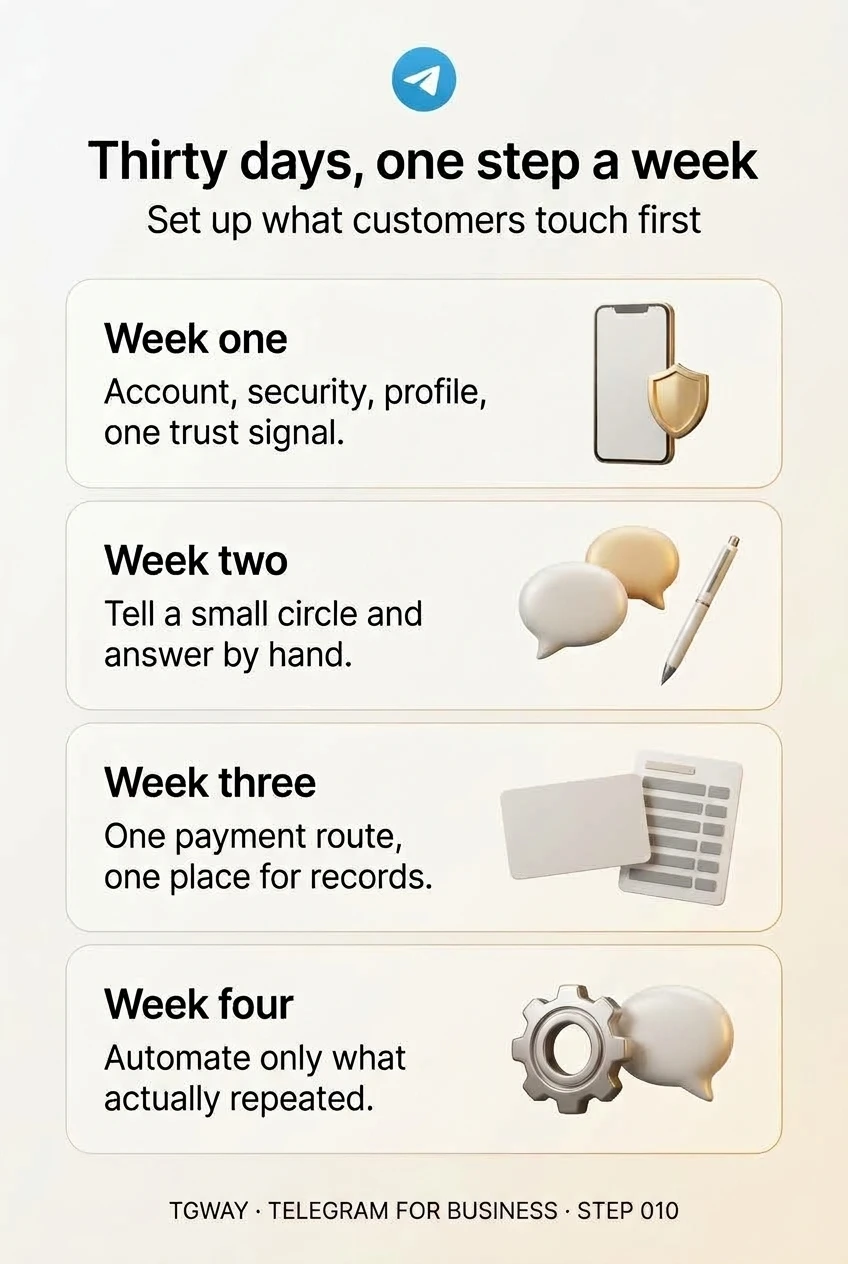
Thirty days, one step a week
The first nine Business steps put in order: what to set up before the first message, what to add as customers arrive, and what to leave until the first month shows it is needed. Tap to open it at full resolution.